A dispensatory, or commentary on the phgarmacopoeias of Great Britain.
- Robert Christison
- Date:
- 1848
Licence: Public Domain Mark
Credit: A dispensatory, or commentary on the phgarmacopoeias of Great Britain. Source: Wellcome Collection.
Provider: This material has been provided by the Harvey Cushing/John Hay Whitney Medical Library at Yale University, through the Medical Heritage Library. The original may be consulted at the Harvey Cushing/John Hay Whitney Medical Library at Yale University.
88/1058 page 38
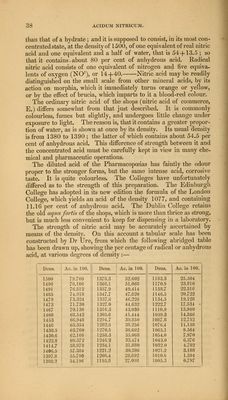
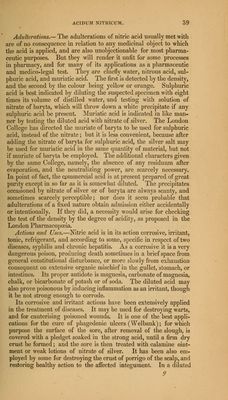
![than that of a hydrate ; and it is supposed to consist, in its most con- centrated state, at the density of 1500, of one equivalent of real nitric acid and one equivalent and a half of water, that is 54 + 13.5 ; so that it contains. about 80 per cent of anhydrous acid. Radical nitric acid consists of one equivalent of nitrogen and five equiva- lents of oxygen (NO5), or 14+40. Nitric acid may be readily distinguished on the small scale from other mineral acids, by its action on morphia, which it immediately turns orange or yellow, or by the effect of brucia, which imparts to it a blood-red colour. The ordinary nitric acid of the shops (nitric acid of commerce, E.) differs somewhat from that just described. It is commonly colourless, fumes but slightly, and undergoes little change under exposure to light. The reason is, that it contains a greater propor- tion of water, as is shown at once by its density. Its usual density is from 1380 to 1390 ; the latter of which contains about 54.5 per cent of anhydrous acid. This difference of strength between it and the concentrated acid must be carefully kept in view in many che- mical and pharmaceutic operations. The diluted acid of the Pharmacopoeias has faintly the odour proper to the stronger forms, but the same intense acid, corrosive taste. It is quite colourless. The Colleges have unfortunately differed as to the strength of this preparation. The Edinburgh College has adopted in its new edition the formula of the London College, which yields an acid of the density 1077, and containing 11.16 per cent of anhydrous acid. The Dublin College retains the old aquafortis of the shops, which is more than thrice as strong, but is much less convenient to keep for dispensing in a laboratory. The strength of nitric acid may be accurately ascertained by means of the density. On this account a tabular scale has been constructed by Dr Ure, from which the following abridged table has been drawn up, showing the per centage of radical or anhydrous acid, at various degrees of density :— Dens. Ac. in 100. Dens. Ac. in 100. Dens. Ac. in 100. 1500 79.700 1378.3 52.602 1183.3 25.504 1496 78.106 1368.1 51.068 1170.9 23.910 1491 76.512 1357.9 49.414 1158.7 22.316 1405 74.918 1347.7 47.820 1146.5 20.722 L479 73.324 1337.6 46.226 1134.5 19.128 1473 71.730 1327.0 44.632 1222.7 17.534 1467 70.136 1316.3 43.038 1110.9 15.940 1 160 68.542 1305.6 41.444 1099.3 14.346 i 153 66.948 1294.7 39.850 1087.8 12.752 l L46 65.864 1282.6 38.256 1076.4 11.158 ] 138.5 68.760 L270.5 36.662 1065.1 9.564 I 180.6 62.166 L 258.3 35.068 L 054.0 7.970 I 122.8 60.572 1246.2 33.474 L 043.0 (..376 111 1.7 58.978 1234.1 31.880 1032.0 4.782 1 106.5 57.384 L221.2 80.286 L 021.2 3.188 1 S97.fi 55.790 L208.4 28.692 L010.6 1.594 54.196 L195.8 27.098 loo:).:', 0.797](https://iiif.wellcomecollection.org/image/b21030212_0088.jp2/full/800%2C/0/default.jpg)
 No text description is available for this image
 No text description is available for this image
 No text description is available for this image