A dispensatory, or commentary on the phgarmacopoeias of Great Britain.
- Robert Christison
- Date:
- 1848
Licence: Public Domain Mark
Credit: A dispensatory, or commentary on the phgarmacopoeias of Great Britain. Source: Wellcome Collection.
Provider: This material has been provided by the Harvey Cushing/John Hay Whitney Medical Library at Yale University, through the Medical Heritage Library. The original may be consulted at the Harvey Cushing/John Hay Whitney Medical Library at Yale University.
96/1058 page 46
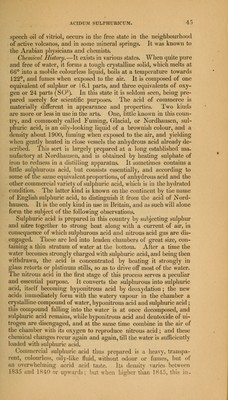
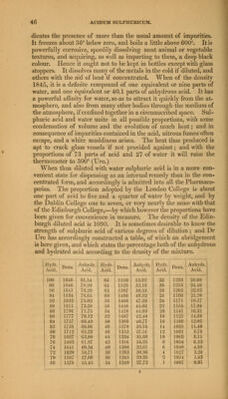
![dicates the presence of more than the usual amount of impurities. It freezes about 36° below zero, and boils a little above 600°. It is powerfully corrosive, speedily dissolving most animal or vegetable textures, and acquiring, as well as imparting to them, a deep black colour. Hence it ought not to be kept in bottles except with glass stoppers. It dissolves many of the metals in the cold if diluted, and others with the aid of heat if concentrated. When of the density 1845, it is a definite compound of one equivalent or nine parts of water, and one equivalent or 40.1 parts of anhydrous acid. It has a powerful affinity for water, so as to attract it quickly from the at- mosphere, and also from many other bodies through the medium of the atmosphere, if confined together in a circumscribed space. Sul- phuric acid and water unite in all possible proportions, with some condensation of volume and the evolution of much heat; and in consequence of impurities contained in the acid, nitrous fumes often escape, and a white muddiness arises. The heat thus produced is apt to crack glass vessels if not provided against; and with the proportions of 73 parts of acid and 27 of water it will raise the thermometer to 300° (Ure.) When thus diluted with water sulphuric acid is in a more con- venient state for dispensing as an internal remedy than in the con- centrated form, and accordingly is admitted into all the Pharmaco- poeias. The proportion adopted by the London College is about one part of acid to five and a quarter of water by weight, and by the Dublin College one to seven, or very nearly the same with that of the Edinburgh College,—by which however the proportions have been given for convenience in measure. The density of the Edin- burgh diluted acid is 1090. It is sometimes desirable to know the strength of sulphuric acid of various degrees of dilution ; and Dr Ure has accordingly constructed a table, of which an abridgement is here given, and which states the percentage both of the anhydrous and hydrated acid according to the density of the mixture. Hydr. Dens. Anhydr. j Hydr. Dens Anhydr. Hydr. Dens. Anhvdr. Acid. Acid. Acid. Acid. Acid. Acid. 100 1848 81.54 66 1550 53.82 32 1233 26.09 98 1846 79.1)0 64 1528 52.18 30 1218 24.46 96 1841 78.28 ' 62 1507 50.55 28 1203 22.83 94 1834 76.65 60 1486 48.92 26 1188 21.20 92 1823 75.02 58 1466 47.29 24 1171 19.57 90 1811 73.39 56 1446 45.66 22 1155 17.94 88 17.% 71.7:. 54 1426 44.03 20 1141 16.31 86 1777 70.12 52 1407 42.40 18 1125 14.68 84 1757 68.49 50 1388 40.77 16 1109 13.05 82 L736 66.86 48 1 370 39.14 14 1095 11.40 80 1712 65.23 46 1353 37.5J 12 1081 9.78 78 1687 63.60 44 1334 35.88 10 1068 8.15 76 1663 61.97 42 1316 34.25 8 1054 a.r>-2 74 164J 60.34 40 1300 32.61 6 1040 4.89 72 1620 68.71 38 1288 30.98 4 1027 3.26 7.1 1597 57.08 B6 1265 29.35 2 10] 1 1.63 L576 55.45 34 1249 27.72 1 1007 (1.81](https://iiif.wellcomecollection.org/image/b21030212_0096.jp2/full/800%2C/0/default.jpg)
 No text description is available for this image
 No text description is available for this image
 No text description is available for this image