Descriptive botany, or, The art of describing plants correctly in scientific language : for self-instruction and the use of schools / by Professor Lindley.
- John Lindley
- Date:
- 1860
Licence: Public Domain Mark
Credit: Descriptive botany, or, The art of describing plants correctly in scientific language : for self-instruction and the use of schools / by Professor Lindley. Source: Wellcome Collection.
26/47
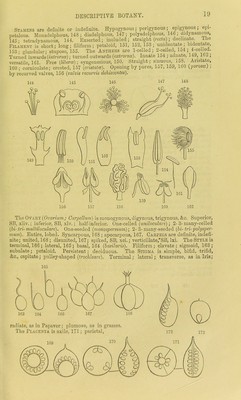
![170; basal, 173 ; sutural, 172; free central, 169 Ribera centralis). Ovules are erect; ascending; pendulous; suspended; horizontal. Anatropal, 174; ortkotropal, 175. Definite; indefinite. Fruit is indehiscent (Achcenium, Nux, Drupa, Oaryopsis, Bacca, Samara, SB, lxxv.; Lomentum, SB, cxxi. 1), or dehiscent (Capsula ; ^ Siliqua, SB, lxxiii.; Legumen, Follicle, SB, lxxxviii.; Pyxis, SB, lxxiv.). 174 175 It dehisces by pores or valves ; its dehiscence is loculicidal, 177; septicidal, 178; septifragal, 176. It is also naked; coronetted {coronatus); corticate when the outer layer separates spontaneously. Monococcous, dicoccous, &c., when it splits spontaneously in the septicidal manner. [In Umbellifers and Composites special terms are employed, some of the more important of which are the following :—Among Umbellifers, the achoenium divides into two carpella (mericarpia), which are half-terete ; hemispherical; compressed laterally; compressed dorsally ; rostrate. Their ridges (juga) are filiform; winged; wavy ; corky (mberosa); marginal; entire ; lacerated; fringed ; membranous. The vittae are commissural when on the commissure. The albumen is solid or convolute. See SB, 67. Among Composites the acheene is beaked (rostratum); erostrate, or beakless ; crowned (coronalvm) ; sessile; stipitate ; terete ; top-shaped (turbi■ natum); furrowed; winged; bald (calvum) when there is no pappus. The Pappus is sessile ; stipitate ; membranous ; paleaceous ; awned (aristatus) ; setaceous ; feathery ((plumosus); rough (scaber); hair-like (pilosus); persistent; deciduous. The receptacle is paleaceous; naked; hairy; fringed; alveolate; fiat; concave; conical. See SB, 82.)] In the Seed the same terms are employed as in the ovule, when referring to position, number, structure, or placentation. Seeds are also terete; spherical; angular; winged (alata); naked; pitted (scvobiculata); netted (reticulata); smooth; striated; polished (polita, nitida); hairy ; shaggy (villosa) ; cottony (lanata); brittle (Crustacea); comose (comata) having long hairs at one end; like sawdust (scobiformia), as in Orchis ; albuminous; exalbuminous. The Albumen is horny (corneum); fleshy {carnosum); oily (oleosum); mealy (farinaceum); solid; ruminate; scanty; copious. The Embryo is monocotyledonous; dicotyledonous; polycotyledonous; acotyledo- nous, as in Cuscuta; straight; annular, 184 ; spiral, 183; external, or lateral, 18-; internal; minute; large; in the axis (axilis). The Radicle is directed to the apex of the fruit (superior); or towards the base (inferior); or vague. The Cotyledons are semiterete; plano-convex; flat (plance); spiral, 181; channelled (concluplicatce); crumpled, 185 (contortuplicatce), as in Convolvulus; accumbeut, 179, or incumbent, 180, in Crucifers. 179 ISO 1S2 184](https://iiif.wellcomecollection.org/image/b28110006_0026.jp2/full/800%2C/0/default.jpg)