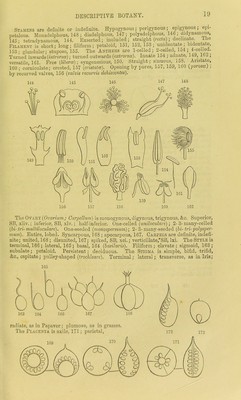
Descriptive botany, or, The art of describing plants correctly in scientific language : for self-instruction and the use of schools / by Professor Lindley.
- John Lindley
- Date:
- 1860
Licence: Public Domain Mark
Credit: Descriptive botany, or, The art of describing plants correctly in scientific language : for self-instruction and the use of schools / by Professor Lindley. Source: Wellcome Collection.
30/47
![DAUCUS CAROTA: The Wild Carrot. Calycifloral Exogens. Nat. Order, Apiaceje, or Umbellifers. Root biennial, slender, tapering, yellowish, aromatic, and sweetish. Stem 2 or 3 feet high, branched, erect, leafy, hairy, scabrous. Leaves alternate, on broad, concave, ribbed footstalks, bipinnate, with narrow, very acute, entire or cut, pilose segments, rough at the edge. Umbels terminating long leafless branches, solitary, large, white, except one central neutral flower, which is blood-red. Bracts of General Involucrum pinnatifid, setaceous, not so long as the umbel ; of the Partial, simple, or 3-cleft, membranous at the edges. Calyx obsolete. Petals 5, obovate, flat, unequal; the larger next the circumference of the umbel. Stamens o, inserted beneath a double epigynous disk; filaments filiform, incurved; anthers oblong, 2-celled, dehiscing longitudinally. Ovary inferior, roundish, striated, hispid, 2-celled ; ovules solitary, pendulous; styles 2, erect, filiform, shorter than the stamens ; stigmas simple. Fruit (protected by the incurvation of all the flower-stalks, by which the umbels are rendered hollow, like a bird’s nest. Smith), compressed from the back, pale dull brown, oval; of the primary ridges, which are narrow, 3 bristly, near the middle of the convex back, the other 2 on the edge of the narrow commissure; secondary deeper and irregularly split into setaceous lobes ; villce, 1 under each secondary ridge, and 2, more slender, on the plane of the commissure. [Obs. 1. The cultivated Carrot, which is a domesticated variety of this, has broader leaves, and differs in some other small particulars.] [Obs. 2. In examining the fruit of any Umbellifer, obtain a thin transverse slice, just when it is beginning to harden, place it in water, and view it by transmitted light. If the fruit is old and hard, it must be boiled for two or three minutes before being sliced.] iETHUSA CYNAPIUM: Fool’s Parsley. Calycifloral Exogens. Nat. Order, Apiaceje, or Umbellifers. Root annual, tapering, whitish. Stem erect, dark lurid green, often purplish, fetid, terete, striated, leafy, a foot high. Leaves smooth, on short sheathing footstalks, ternate, with slender-stalked, tripar- tite, cut, somewhat cuneate lobes. Umbels stalked, terminal, spreading and flattish. General involucre 0; partial one-sided, of 3 linear, acute, pendulous bracts. Flowers small, pure white, partially abortive. Calyx obsolete. Petals 5, obcordate, with tho points indexed, those near the circumference largest. Stamens 5, epigynous, incurved. Ovary inferior, oblong, striated, 2-cclled, smooth; ovule solitary, pendulous; styles 2, spreading, short, filiform; stigmas simple. Fruit pale brown, ovate, 2 lines long, without any remains of a calyx; ridges thick, corkv sharp the dorsal ones rather the narrowest; villa! under the furrows solitary, very slender* upon the commissure 2, blood red, curved, more distant at the base than at the apex; albumen terete.](https://iiif.wellcomecollection.org/image/b28110006_0030.jp2/full/800%2C/0/default.jpg)