[Report 1959] / Medical Officer of Health, Edinburgh City.
- Edinburgh (Scotland). City Council
- Date:
- 1959
Licence: Attribution 4.0 International (CC BY 4.0)
Credit: [Report 1959] / Medical Officer of Health, Edinburgh City. Source: Wellcome Collection.
41/242 (page 41)
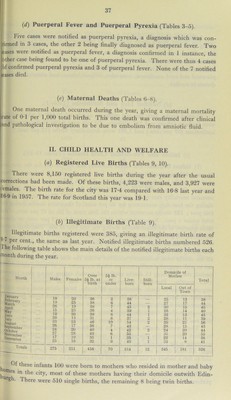
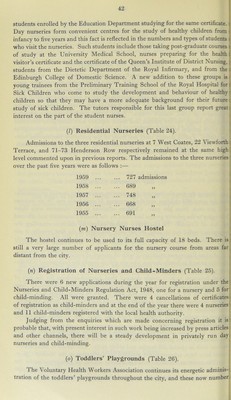
![U in the region. It is always sad to see something disappear which has been a productive of much good in the past but the new arrangements have worked well I since they began. (j) Vaccinations and Immunisations The number of infants successfully vaccinated against smallpox at the child ' welfare clinics was 3,095. In addition, 2,646 infants and young children were I protected against diphtheria by formol toxoid, while 229 completed diphtheria- pertussis inoculations commenced elsewhere, and 10 completed triple antigen courses also begun elsewhere. Thus 2,885 children were protected against diphtheria at child welfare clinics. Some 2,365 infants received suspended whooping cough vaccine courses, and these, together with those given combined and triple antigen numbered 2,604 infants protected against whooping cough at the clinics. Family doctors carry out many of the protective inoculations now- adays, and this applies in particular to poliomyelitis vaccination, details of which are found elsewhere in the Medical Officer of Health’s report. (k) Day Nurseries (Table 23) During the year the fourteen day nurseries continued to provide accommoda- * tion for some 688 children and the percentage of attendance was 79, an increase * of 2 per cent, from last year. Children admitted to the nurseries were those ; belonging to the priority groups laid down by the Health Committee and affirmed by Act of Council. In this year’s annual survey of children attending the a nurseries, carried out in June, 90 per cent, belonged to the first priority, 6 per «cent, to the second, while the remaining 4 per cent, were admitted temporarily 1 because of financial stress in the home. A close liaison was maintained with all groups of social workers and welfare s agencies as well as family doctors who are able to supply the background informa- 1 tion necessary before allocation to priority groups can be made. There con- 1 tinued, however, to be a steady demand from married students for the care of l their children to enable both parents to continue their courses of study. To these * applicants we are unable to offer any help except to supply them with lists of ] private nurseries and child minders registered with the local health authority. * A proportion of these students come from overseas and have accepted places in 1 courses of study in the belief and hope that there will be daily care readily ; available for their children. An interesting experiment in accident prevention was carried out in three day nurseries where groups of children were tested with various forms of safety ' devices such as special pill-bottles and safety locks. The results of these experi- ments have been submitted and accepted for publication in the Medical Officer. The nurseries continued to act as training centres for girls preparing for the * Scottish Nursery Nurses Examination Board’s certificate. In addition, the nurseries were used for giving practical training in infant and child care to](https://iiif.wellcomecollection.org/image/b28651534_0043.jp2/full/800%2C/0/default.jpg)