Essays on the puerperal fever and other diseases peculiar to women : Selected from the writings of British authors previous to the close of the eighteenth century / Ed. by Fleetwood Churchill.
- Fleetwood Churchill
- Date:
- 1849
Licence: Public Domain Mark
Credit: Essays on the puerperal fever and other diseases peculiar to women : Selected from the writings of British authors previous to the close of the eighteenth century / Ed. by Fleetwood Churchill. Source: Wellcome Collection.
Provider: This material has been provided by the Harvey Cushing/John Hay Whitney Medical Library at Yale University, through the Medical Heritage Library. The original may be consulted at the Harvey Cushing/John Hay Whitney Medical Library at Yale University.
524/580 page 512
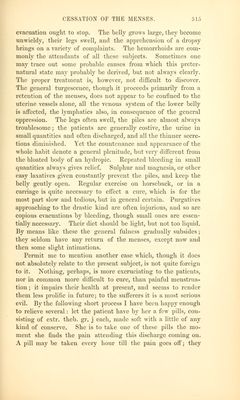
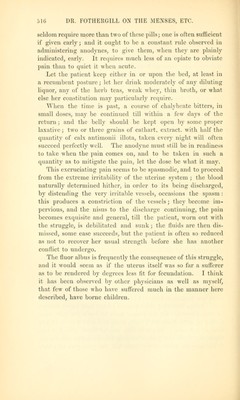
![occasion for such artificial evacuation diminishes, and the pa- tient's health becomes firmly established.1 An opinion in favour of issues at this period of life has oc- cupied the minds of many patients; some with the hopes of preventing all future evils capable of proceeding from this cause; others with the terror of carrying about with them for lite a drain which they think of with extreme disgust. Per- haps the use of these outlets deserves some consideration. When a patient has, in early life, been subject to cutaneous eruptions, sore eyes, glandular swellings, or other obvious marks of morbid humour subsisting in the constitution, and all which may have disappeared about the time the menses became regular, if no invincible opposition is made to it, a drain is now certainly advisable and may prevent many inconveniences.2 Should any cutaneous foulnesses, any ulcerations, any fugi- tive pains of the cancerous or rheumatic kind, hardnesses in 1 [We possess two direct remedies for these excessive discharges, which were not in use in Dr. Fothergill's time. I mean ergot of rye, and tincture of Indian Kemp. The former has long heen known to possess the power of restraining hemorrhage after delivery, and of late years it has been used in menorrhagia with great success. I can bear witness to its great value after a long and extensive trial. I generally order from five to ten grains of the powder to be taken three times a day, and if there be no ulceration, the discharge will generally be arrested in a day or two. The property of the Indian hemp, of restraining uterine hemorrhage, has only been known to the profession a year or two. It was accidentally discovered by my friend Dr. Magnire of Castleknock, and since then it has been extensively tried by different medical men in Dublin, and by myself, with considerable success. The tincture of the resin is the most efficacious preparation, and it may lie given in doses of from five to fifteen or twenty drops, three times a day, in water. Its effects, in many cases, are very marked, often instantaneous, but generally complete after three or four doses. In some few cases of ulceration, in which I have tried it on account of the hemorrhage, it seemed to be equally beneficial. 1 may be allowed to add a word as to the value of cold applications in these cases of menorrhagia. I have found great benefit from encmata of cold water, and these appeared to lie less unpleasant to the patient than vaginal injections. Should the former fail, however, the latter may be tried, and either cold water, alum and water, decoction of oak-bark, galls or matieo, he used. When the womb remains congested and enlarged after the arrest of the hemorrhage, greal benefit will be derived from the application of caustic tincture of iodine, once or twice a week, by means of the speculum.—El).] 2 [I have repeatedly tried caustic issues or perpetual UNtcrs. and with the greatest advantage. They certainly aid the operation of the remedies already mentioned,and, I think, prevent the recurrence of those irregular congestions which Dr. FothergiU has described.—Em]](https://iiif.wellcomecollection.org/image/b21030170_0524.jp2/full/800%2C/0/default.jpg)