Essays on the puerperal fever and other diseases peculiar to women : Selected from the writings of British authors previous to the close of the eighteenth century / Ed. by Fleetwood Churchill.
- Fleetwood Churchill
- Date:
- 1849
Licence: Public Domain Mark
Credit: Essays on the puerperal fever and other diseases peculiar to women : Selected from the writings of British authors previous to the close of the eighteenth century / Ed. by Fleetwood Churchill. Source: Wellcome Collection.
Provider: This material has been provided by the Harvey Cushing/John Hay Whitney Medical Library at Yale University, through the Medical Heritage Library. The original may be consulted at the Harvey Cushing/John Hay Whitney Medical Library at Yale University.
533/580 page 521
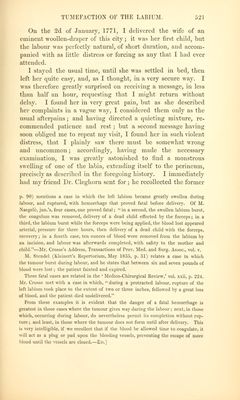
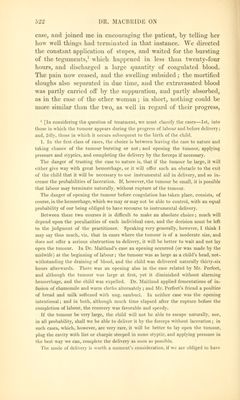
![On the 2d of January, 1771, I delivered the wife of an eminent woollen-draper of this city; it was her first child, but the labour was perfectly natural, of short duration, and accom- panied with as little distress or forcing as any that I had ever attended. I stayed the usual time, until she was settled in bed, then left her quite easy, and, as I thought, in a very secure way. I was therefore greatly surprised on receiving a message, in less than half an hour, requesting that I might return without delay. I found her in very great pain, but as she described her complaints in a vague way, I considered them only as the usual afterpains; and having directed a quieting mixture, re- commended patience and rest; but a second message having soon obliged me to repeat my visit, I found her in such violent distress, that I plainly saw there must be somewhat wrong and uncommon; accordingly, having made the necessary examination, I was greatly astonished to find a monstrous swelling of one of the labia, extending itself to the perineum, precisely as described in the foregoing history. I immediately had my friend Dr. Cleghorn sent for; he recollected the former p. 90) mentions a case in which the left labium became greatly swollen during labour, and ruptured, with hemorrhage that proved fatal before delivery. Of M. Naegele, jun.'s, four cases, one proved fatal; in a second, the swollen labium burst, the coagulum was removed, delivery of a dead child effected by the forceps; in a third, the labium burst while the forceps were being applied, the blood lost appeared arterial, pressure for three hours, then delivery of a dead child with the forceps, recovery; in a fourth case, ten ounces of blood were removed from the labium by an incision, and labour was afterwards completed, with safety to the mother and child.—Mr. Crosse's Address, Transactions of Prov. Med. and Surg. Assoc, vol. v, M. Stendel (Kleinert's Repertorium, May 1835, p. 31) relates a case in which the tumour burst during labour, and he states that between six and seven pounds of blood were lost; the patient fainted and expired. Three fatal cases are related in the ' Medico-Chirurgical Review,' vol. xxii, p. 224. Mr. Crosse met with a case in which, during a protracted labour, rupture of the left labium took place to the extent of two or three inches, followed by a great loss of blood, and the patient died undelivered. From these examples it is evident that the danger of a fatal hemorrhage is greatest in those cases where the tumour gives way during the labour; next, in those which, occurring during labour, do nevertheless permit its completion without rup- ture ; and least, in those where the tumour does not form until after delivery. This is very intelligible, if we recollect that if the blood be allowed time to coagulate, it will act as a plug or pad upon the bleeding vessels, preventing the escape of more blood until the vessels are closed.—Ed.]](https://iiif.wellcomecollection.org/image/b21030170_0533.jp2/full/800%2C/0/default.jpg)