Tuberculosis; a treatise by American authors on its etiology, pathology, frequency, semeiology, diagnosis, prognosis, prevention and treatment.
- Arnold Klebs
- Date:
- 1909
Licence: Public Domain Mark
Credit: Tuberculosis; a treatise by American authors on its etiology, pathology, frequency, semeiology, diagnosis, prognosis, prevention and treatment. Source: Wellcome Collection.
Provider: This material has been provided by the Augustus C. Long Health Sciences Library at Columbia University and Columbia University Libraries/Information Services, through the Medical Heritage Library. The original may be consulted at the the Augustus C. Long Health Sciences Library at Columbia University and Columbia University.
63/990 page 27
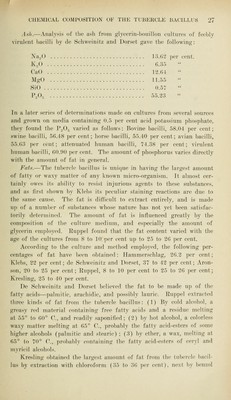
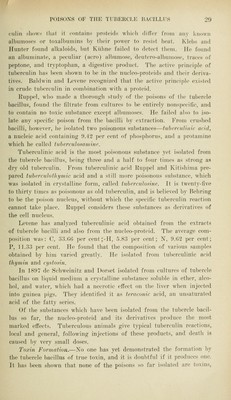
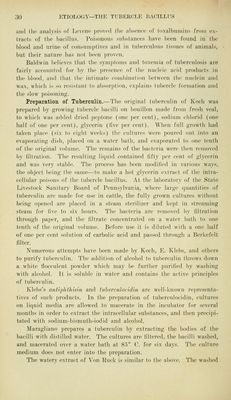
![Asli.—Analysis of the ash from glycerin-bouillon cultures of feebly virulent bacilli by de Schweinitz and Dorset gave the following: NaoO 13.62 per cent. KJ) 6.35 CaO 12.64 MgO 11.55 SiO 0.57 P.O, 55.23 In a later series of determinations made on cultures from several sources and groMTi on media containing 0.5 per cent acid potassium phosphate, they found the P2O5 varied as follows: Bovine bacilli, 58.04 per cent; swine bacilli, 56.48 per cent; horse bacilli, 55.40 per cent; avian bacilli, 55.63 per cent; attenuated human bacilli, 74.38 per cent; virulent human bacilli, 60.90 per cent. The amount of phosphorus varies directly with the amount of fat in general. Fats.—The tubercle bacillus is unique in having the largest amount of fatty or waxy matter of any known micro-organism. It almost cer- tainly owes its ability to resist injurious agents to these substances, and as first shown by Klebs its peculiar staining reactions are due to the same cause. The fat is difficult to extract entirely, and is made up of a number of substances whose nature has not yet been satisfac- torily determined. The amount of fat is influenced greatly by the composition of tlie culture medium, and especially the amount of gl3'cerin employed. Euppel found that the fat content varied with the age of the cultures from 8 to 10 per cent up to 25 to 26 per cent. According to the culture and method employed, the following per- centages of fat have been obtained: Hammerschlag, 26.2 per cent; Klebs, 22 per cent; de Schweinitz and Dorset, 37 to 42 per cent; Aron- son, 20 to 25 per cent; Euppel, 8 to 10 per cent to 25 to 26 per cent; Kresling, 25 to 40 per cent. De Schweinitz and Dorset believed the fat to be made up of the fatty acids—palmitic, arachidic, and possibly lauric. Ruppel extracted three kinds of fat from the tubercle bacillus: (1) By cold alcohol, a greasy red material containing free fatty acids and a residue melting at 55° to 60° C, and readily saponified; (2) by hot alcohol, a colorless waxy matter melting at 65° C. probably the fatty acid-esters of some higher alcohols (palmitic and stearic) ; (3) by ether, a wax, melting at 65° to 70° C, proba])ly containing the fatty acid-esters of ceryl and triyricil alcohols. Kresling obtained the largest amount ol* fat from the tubercle bacil- lus by extra(ttion with chloroform (35 to 36 per cent), next by benzol](https://iiif.wellcomecollection.org/image/b21216423_0063.jp2/full/800%2C/0/default.jpg)