Tuberculosis; a treatise by American authors on its etiology, pathology, frequency, semeiology, diagnosis, prognosis, prevention and treatment.
- Arnold Klebs
- Date:
- 1909
Licence: Public Domain Mark
Credit: Tuberculosis; a treatise by American authors on its etiology, pathology, frequency, semeiology, diagnosis, prognosis, prevention and treatment. Source: Wellcome Collection.
Provider: This material has been provided by the Augustus C. Long Health Sciences Library at Columbia University and Columbia University Libraries/Information Services, through the Medical Heritage Library. The original may be consulted at the the Augustus C. Long Health Sciences Library at Columbia University and Columbia University.
71/990 page 35
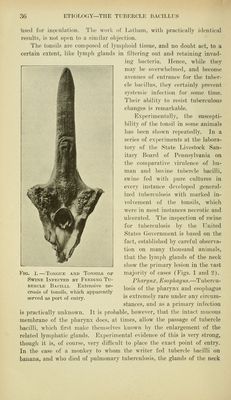
![haud, facts, both ('xjjcriiu<,'utal ami clinical, are constaullv accunui- lating which prove that the digestive tract is an important, if not the most important, avenue of entry for the tubercle bacillus. As early as 1868 Chauveau showed that infection of cattle was readily produced by feeding, and since that time numerous experimenters have obtained positive results, often when only a single infected meal was given. The matter was brought to the front by Koch, in his London ad- dress, 1901. In discussing the importance of bovine tuberculosis in relation to human health, he took the ground that infection through food could be assumed with certainty only when the primary lesion was located in the intestine, and on the claim that this was seldom the case, based his opinion as to the slight importance of guarding our food products. In considering infection through the digestive tract, a question at once arises as to the correctness of the premise laid down by Koch, which assumes that the tubercle bacillus cannot enter the system through the intestinal wall without the production of a lesion at the point of entrance. It leaves out of consideration the possibility of infection through any other part of the alimentary tract, which should be taken to include the entire apparatus with which the food comes in contact, beginning with the mouth. Mouth and Tongue, Palate and Gums.—Tuberculosis of the mouth, gums, palate, and tongue is rare, even as a secondary manifestation in advanced phthisis, when all these structures are constantly exposed to large quantities of sputum containing myriads of tubercle bacilli. Ex- perimentally, infection of these tissues, with enlargement and caseation of the related glands, is fairl}^ easily produced, but as primary avenues of entrance, under natural conditions, they play an insignificant part. Tonsils.—The same cannot be said of the tonsils, which are not infrequently the seat of apparently primary tuberculosis, and constantly show scars, giant cells, and other changes attril>utable often to tubercu- losis. By inoculation of guinea pigs Dieulafoy found tuberculosis of the tonsil in 15 of 96 cases. Latham, who was careful to use only tlie interior portions of the tonsil, in 45 consecutive autopsies on children from three months to thirteen years of age, found 7 which were tulxn-- culous. Confirmatory results have been obtained by Baup, Friodniann, and other observers. The tonsils are very frequently tul)erculous in persons who die of phthisis. AValsham found tubercles in 21 of 3-L cases examined ]»ost-mortem, and in several he considered the lesion primary. Tubercle bacilli may be lodged in the tonsillar crypts and remain there a longer or shorter time without producing tuberculosis of the tonsil. The results of Dieulafoy have been severely criticised on this ground, and properly so, since he made no histologic examination of the tissues](https://iiif.wellcomecollection.org/image/b21216423_0071.jp2/full/800%2C/0/default.jpg)