[Report 1952] / Medical Officer of Health, Nottinghamshire County Council.
- Nottinghamshire County Council
- Date:
- 1952
Licence: Attribution 4.0 International (CC BY 4.0)
Credit: [Report 1952] / Medical Officer of Health, Nottinghamshire County Council. Source: Wellcome Collection.
149/162 page 147
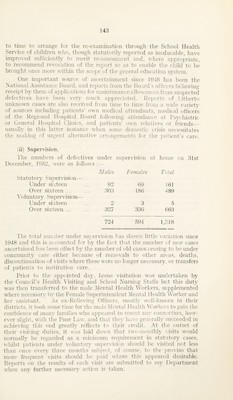
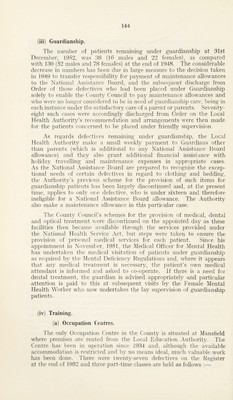
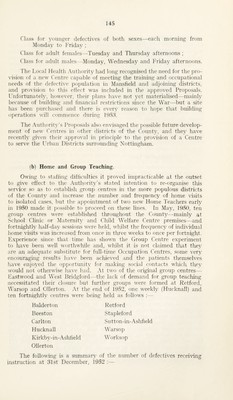
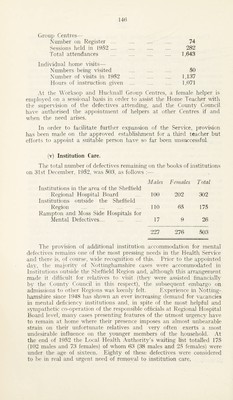
![As was only to be exj^iected, practically all available accommodation has now been utilised and the situation has gradually deteriorated to such an extent that it is now extremely rare to find vacancies either for cliildren or for adult males and lower-grade females. Ever^^ effort is made, in co-o})eration with the Regional Psychiatrist, to try to ensure that the most urgent cases receive priority but this becomes a most difficult achievement when there are many whose need is so acute. Often the clinical needs and ]X)tentialities of the defectives themselves (surel}' a most important factor in normal circumstances) must be sub¬ ordinated to considerations of home background and environment and, regrettable though it may be, the lu'eds of defectives in good homes have to be ignored in faA’our of those whose environment is poor. Reference has been made in previous reports to the position of the delinquent defective considered by Courts to be in need of institution care and contnd aiid to the fact that use has had to be made of prisons as places of safety pending the pro\’ision of institution vacancies. This practice still continues and I re-affirm my predecessor’s opinion that, unavoidable though it may be, it can only have the effect of bringing the Mental Deficiency Acts into disrepute, even though I know that such cases are afforded the highest priority by the Regional Hospital Board in the allocation of \’acancies. I am not aware of the latest stage in the development of the Balderton Colony, near Newark—originally planned by the County Council before the War—but I can see little prospect of any general improvement in the situation locally until it is opened for the reception of patients. Relationships between the Authority’s officers and the officers of the Regional Hospital Board, both at Headquarters and Institutions, have been excellent and I have always found a ready willingness to help. Refer¬ ence is made in the succeeding item to the work undertaken by the Local Health Authority’s ofheers on behalf of Hospital Management Com¬ mittees, but it is appropriate to mention he e that it has been the practice since 1948 to prepare reports on home conditions for the information of the Visitors in connection with the re-consideration of Orders and to undertake any miscellaneous enquiries on request. (vi) Licence. According to information supplied by institutions, the number of Nottinghamshire patients on licence at olst December, 1952, was 49 (19 males and 30 females) of whom 27 (12 males and 15 females) were residing within the County area. In accordance with the practice which has operated since the appointed day, the Authority’s Mental Health Workers carried out, on behalf of Hospital Management Committees, the routine supervision of patients on licence in the County, and progress reports were forwarded to institutions at two-monthly intervals. Appropriate advice and assistance has been extended to patients newly sent out on licence in their re¬ adjustment to life in the community and, in suitable cases, help has been given in hnding employment within the capacity of the patients concerned. Medical examination of licence patients has been nndertaken](https://iiif.wellcomecollection.org/image/b29925344_0149.jp2/full/800%2C/0/default.jpg)