On the underground water supply of the country : with particulars of the reasons for the formation of the Association and facts collected in relation thereto / issued by the Executive Committee of the Association ; edited by Clayton Beadle and Wm. May.
- Date:
- [1902?]
Licence: Public Domain Mark
Credit: On the underground water supply of the country : with particulars of the reasons for the formation of the Association and facts collected in relation thereto / issued by the Executive Committee of the Association ; edited by Clayton Beadle and Wm. May. Source: Wellcome Collection.
3/182
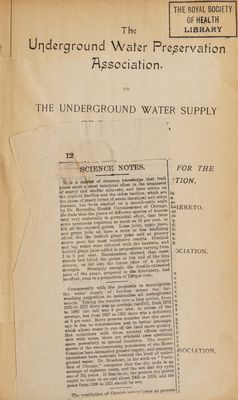
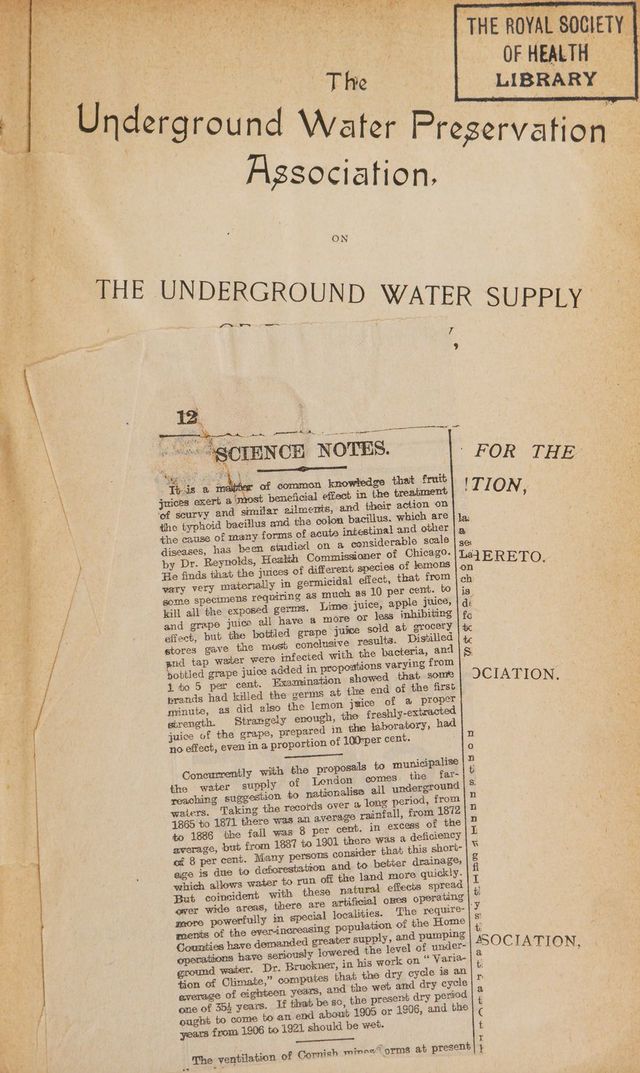
![POE Nope ee Uae a nderground Water Pregervation — 4 Agsociation. eS ¥ ‘ THE UNDERGROUND WATER SUPPLY e i Ree ke Syaae Wes : Th is a mather of common knowtedge that fruit] | juices exert a ost beneficial effect in the cokes pL LON; ‘of scurvy and similar ailments, and their action on the typhoid bacillus and the colon bacillus, which are } ja: the cause of many forms of acute intestinal and other |p | fa aoe ie | es aeons on a considerable scale | se ae aaah y Dr. Reynokds, ealth Commissioner of Chicago. | La eae He finds that the juices of different species of lemons ba ERETO ; eee as, vary very materially in germicidal effect, that from | ch: ae a gome specimens requiring as much as 10 per cent. to Hs “y(t Ne kill all the exposed germs. Lime juice, apple juice, | gq: ; aod and grape juice all have a more or less inhibiting | fo ue effect, but the bottled grape juiwe sold at grocery | tc BOG ek ee stores gave the most conclusive results. Distilled | ¢ a ae nd tap water were infected with the bacteria, and) ¢ . aera pottled grape juice added in propostions varying from ea 1 to 5 per cent. Examination showed that some} JCI ATION. prands had killed the germs at the end of the first : minute, as did elso the lemon jmice of a proper +, de strength. Strangely enough, the freshly-extracted . Be. juice of the grape, prepared in_ the Jaboratory, had at no effect, even in a proportion of 100:per cent. nu sett hese o Ba ie Concurrently with the proposals to municipalise | 2 | ee the water supply of Lendon contres the far- b . iat reaching suggestion to nationalise all underground | * ay ree waters. Taking the records over a long period, from = Ait ae 1865 to 1871 there was an average rainfall, rome 1ele | Mey, Ge to 1886 the fall was 8 per cent, in excess of the|? ban ie average, but from 1887 to 1901 there was & deficiency [ Famer ey: of 8 per cent. Many persons consider that this short- | * Ra age is due to deforestation and to better drainage, g which allows water to run off the land more quickly. fi But coincident with these natural effects spread I ars: over wide areas, there are artificial ones operating | ” etn more powerfully im special localities. The require- | 7 aia ments of the ever-increasing pulation of the Home ‘a 3 Counties have demanded greater supply, and pumping 3 Se aye seriously lowered the level of under SOCIATION, | | d water. Dr. Bruckner, in his work on “ Varia- : ( tion of Climate,” computes that the dry cycle is an| . average of eighteen years, and the wet and dry cycle a one of 35} years. If that be so, the present dry period ; ought bo come to an end about 1905 or 1906, and the C | years from 1906 to 1921 should be wet. t Y t ad The ventilation of Cornish mines“ orms at present ”. ~ ¢ (](https://iiif.wellcomecollection.org/image/b28997438_0003.jp2/full/800%2C/0/default.jpg)