Licence: In copyright
Credit: Manual of surgery / by Alexis Thomson and Alexander Miles. Source: Wellcome Collection.
Provider: This material has been provided by the Royal College of Physicians of Edinburgh. The original may be consulted at the Royal College of Physicians of Edinburgh.
89/856 (page 61)
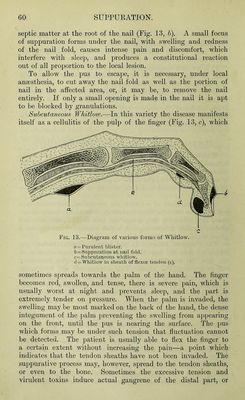
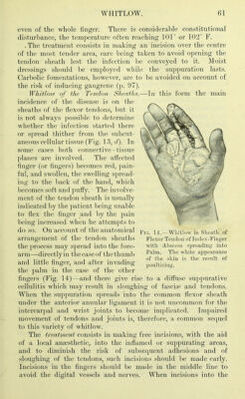
![even of the whole finger. There is considerable constitutional disturbance, the temperature often reaching 101° or 102° F. . The treatment consists in making an incision over the centre of the most tender area, care being taken to avoid opening the tendon sheath lest the infection be conveyed to it. Moist dressings should be employed while the su})])uration lasts. Carbolic fomentations, however, are to be avoided on account of the I’isk of inducing gangrene (p. 97). Whitlow of the Tendon Sheathx.—In this form the main incidence of the disea.se is on the sheaths of the fiexor tendon,s, but it is not always possible to determine whether the infection started there or spread thither from the subcut- aneous cellular tissue (Fig. 13, d). In some cases both connective - tissue planes are involved. The affected finger (or fingers) becomes red, pain- ful, and swollen, the swelling spread- ing to the back of the hand, which becomes .soft and puffy. The involve- ment of the tendon sheath is usually indicated by the patient being unable to lle.x the finger and by the pain being increased when he attempts to do so. On account of the anatomical arrangement of the tendon sheaths Wfiitlow in Sheatli of Flexor Tendon of Index-Finger with Abscess spreading into Palm. The white appearance of the skin is the result of poulticing. the [)rocess may spread into the fore- arm—directly in the case of the thumb and little finger, and after invading the palm in the case of the other fingers (Fig. 14)—and there give rise to a diffuse suppurative cellulitis which may result in sloughing of fascim and tendons. When the suppuration spreads into the common fiexor sheath under the anterior annular ligament it is not uncommon for the intei'carpal and wrist joints to become imi)licated. Impaired movement of tendons and joints is, therefore, a common sequel to this variety of whitlow. The treatnient consists in making free incisions, with the aid of a local anaesthetic, into the inflamed or suppurating areas, and to diminish the risk of subsequent adhesions and of sloughing of the tendons, such incisions should be made early. Incisions in the fingers should be made in the middle line to avoid the digital vessels and nerves. When incisions into the](https://iiif.wellcomecollection.org/image/b21933194_0001_0089.jp2/full/800%2C/0/default.jpg)