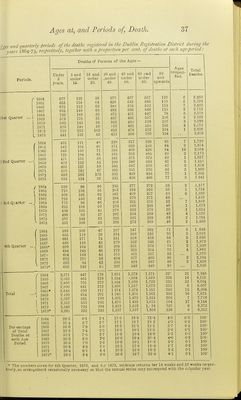
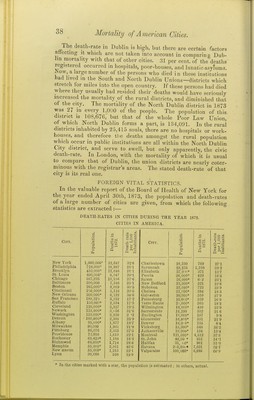
A manual of hygiene, public and private, and compendium of sanitary laws : for the information and guidance of public health authorities, officers of health, and sanitarians generally / by Charles A. Cameron.
- Date:
- 1874
Licence: Public Domain Mark
Credit: A manual of hygiene, public and private, and compendium of sanitary laws : for the information and guidance of public health authorities, officers of health, and sanitarians generally / by Charles A. Cameron. Source: Wellcome Collection.
Provider: This material has been provided by the Royal College of Physicians of Edinburgh. The original may be consulted at the Royal College of Physicians of Edinburgh.
51/522 (page 39)
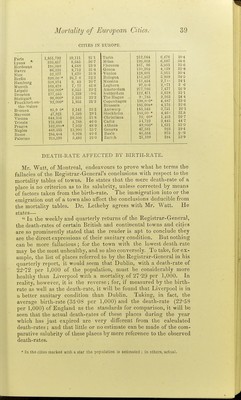
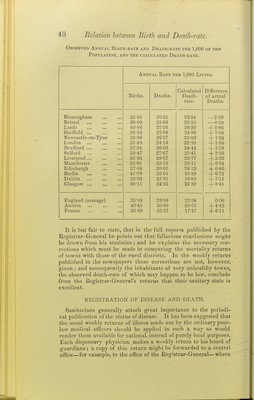
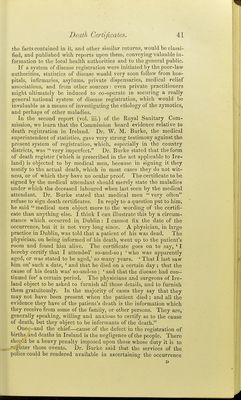
![CITIES IN EUUOPE. Fari3 ^ Lyons Bordeaux Havre Nice Btrlin Hamburg Munich Leipsic Dresilen Stuttgart Franklort-on- the-Maine Bremen Mayence Vienna Trieste PraRne Naples Rome Palermo 1,851,792 323,417 194,000 86,325 52,377 828,00'* 338,974 169,478 110,000* 177,055 90,000* 92,000* 85,0 0* 47,821 644,356 125,648 162,00U» 448,335 244,4!-4 2ia,398 39,111 8,645 4,648 2,712 1,670 26,7 6 9, 49 7,1 77 2,553 5,239 2,226 1,'955 2,142 1,399 20,506 6,788 7,932 15,996 9,924 5,493 21-1 . Turin 212,644 6,476 30-4 26-7 Milan 199,009 6,897 34-6 23-9 Hloreuce 167, 96 130,269 5,953 35 0 31-4 Genoa 4,139 3,916 31-8 31-8 Venice 128,901 30-4 32-3 Bologna 110,957 3,999 34-5 26-7 Messina 111,854 2,7 11 24-1 41-8 Leghorn 97,0!'6 2,!>71 7,477 3 -6 23-2 Amsteidam 277,766 26 9 v9-6 hotterdim 122,471 3,818 31-1 23-2 The Hague . 9!,785 2,263 244 21-2 Copenhagen 190,(l('0* 4,487 23-6 Brussels 185,000* 4,178 22-6 252 Antweip 143,545 3,751 26-1 29-1 Stockholm 140,00i * 4,46 ] 31.8 31-8 Christiana 70,' 00* 1,453 20-7 46-0 Ca.riiz 5 1,732 2,445 44-7 48-9 Athens 49,000* 1,621 33 0 35-7 Geneva 47,581 923 19-4 40 6 Basle 40,554 975 2--9 25-0 Zurich 21,199 294 13-9 DEATH-RATE AFFECTED BY BIRTH-RATE. Mr. Watt, of Montreal, endeavours to prove what he terms the fallacies of the Eegistrar-General's conclusions with respect to the mortality tables of towns. He states that the mere death-rate of a place is no criterion as to its salubrity, unless corrected by means of factors taken from the birth-rate. The immigration into or the emigration out of a town also affect the conclusions deducible from the mortality tables. Dr. Letheby agrees with Mr. Watt. He states— In the weekly and quarterly returns of the Registrar-General, the death-rates of certain British and continental towns and cities are so prominently stated that the reader is apt to conclude they are the direct expressions of their sanitary condition. But nothing can be more fallacious; for the town with the lowest death-rate may be the most unhealthy, and so also conversely. To take, for ex- ample, the list of places referred to by the Registrar-General in his quarterly report, it would seem that Dublin, with a death-rate of 22*72 per 1,000 of the population, must be considerably more healthy than Liverpool with a mortality of 2729 per 1,000. In reality, however, it is the reverse; for, if measured by the birth- rate as well as the death-rate, it will be found that Liverpool is in a better sanitary condition than Dublin. Taking, in fact, the average birth-rate (35-08 per 1,000) and the death-rate (22-58 per 1,000) of England as the standards for comparison, it will be seen that the actual death-rates of these places during the year which has just expired are very different from the calculated death-rates; and that little or no estimate can be made of the com- parative salubrity of these places by mere reference to the observed death-rates.](https://iiif.wellcomecollection.org/image/b21932396_0051.jp2/full/800%2C/0/default.jpg)