A manual of hygiene, public and private, and compendium of sanitary laws : for the information and guidance of public health authorities, officers of health, and sanitarians generally / by Charles A. Cameron.
- Date:
- 1874
Licence: Public Domain Mark
Credit: A manual of hygiene, public and private, and compendium of sanitary laws : for the information and guidance of public health authorities, officers of health, and sanitarians generally / by Charles A. Cameron. Source: Wellcome Collection.
Provider: This material has been provided by the Royal College of Physicians of Edinburgh. The original may be consulted at the Royal College of Physicians of Edinburgh.
72/522 (page 60)
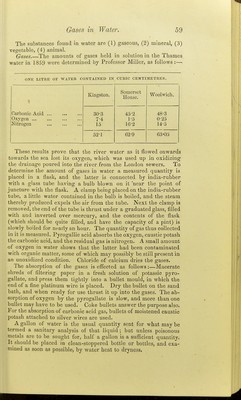
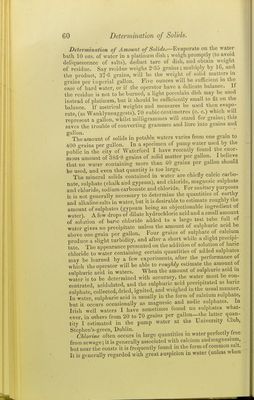
![Determination of Amount of Solids.—E\a]yoTSLte on the water bath 10 ozs. of water in a platinum dish ; weigh promptly (to avoid deliquescence of salts), deduct tare of dish, and obtain weight of residue. Say residue weighs 2-35 grains; multiply by 16, and the product, 37-6 grains, will be the weight of solid matters in grains per imperial gallon. Five ounces will be sufficient m the case of hard water, or if the operator have a delicate balance. If the residue is not to be burned, a light porcelain dish may be used instead of platinum, but it should be sufficiently small to fit on the balance. If metrical weights and measures be mei then evapo- rate, (as Wanklynsuggests), 70 cubic centimetres (c. c.) which will represent a gallon, whilst milligrammes will stand for grains; this saves the trouble of converting grammes and litre into grains and gallon. . , . . The amount of solids in potable waters varies from one grain to 400 grains per gallon. In a specimen of pump water used by the public in the city of Waterford I have recently found the enor- mous amount of 385-8 grains of solid matter per gallon. I believe that no water containing more than 40 grains per gallon should be used, and even that quantity is too large. The mineral solids contained in water are chiefly calcic carbo- nate, sulphate (chalk and gypsum), and chloride, magnesic sulphate and chloride, sodium carbonate and chloride. For sanitary purposes ii is not generally necessary to determine the quantities of earthy and alkaline salts in water, but it is desirable to estimate roughly the amount of sulphates (gypsum being an objectionable ingredient ot water). A few drops of dilute hydrochloric acid and a smaU amount of solution of banc chloride added to a large test tube full ot water gives no precipitate unless the amount of sulphuric acid be above one grain per gallon. Four grains of sulphate of calcium produce a slight turbidity, and after a short while a slight precipi- tate. The appearance presented on the addition of solution of banc chloride to water containing certain quantities of added sulphates may be learned by a few experiments, after the performance ot which the operator will be able to roughly estimate the amount ot sulphuric acid in waters. When the amount of sulphuric acid in water is to be determined with accuracy, the water must be con- centrated, acidulated, and the sulphuric acid precipitated as banc sulphate, collected, dried, ignited, and weighed in the usual manner. In water, sulphuric acid is usually in the form of calcium sulphate, but it occurs occasionally as magnesic and sodic su phates. In Irish well waters I have sometimes found no sulphates what- ever, in others from 20 to 70 grains per gallon-the latter quan- tity I estimated in the pump water at the University Club, Stephen's-green, Dublin. _ , „ Chlorine often occurs in large quantities in water perfectly tree from sewage: it is generally associated with calcium and magnesium, but near the coasts it is frequently found in the form of common salt. It is generally regarded with great suspicion in water (unless wnen](https://iiif.wellcomecollection.org/image/b21932396_0072.jp2/full/800%2C/0/default.jpg)