The diagnosis and medical treatment of acute intestinal obstruction / by Reginald H. Fitz.
- Reginald Heber Fitz
- Date:
- 1889
Licence: Public Domain Mark
Credit: The diagnosis and medical treatment of acute intestinal obstruction / by Reginald H. Fitz. Source: Wellcome Collection.
Provider: This material has been provided by The Royal College of Surgeons of England. The original may be consulted at The Royal College of Surgeons of England.
58/68
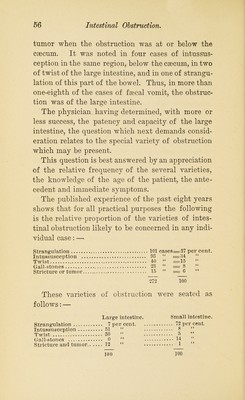
![tumor when the obstruction was at or below the caecum. It was noted in four cases of intussus- ception in the same region, below the caecum, in two of twist of the large intestine, and in one of strangu- lation of this part of the bowel. Thus, in more than one-eighth of the cases of faecal vomit, the obstruc- tion was of the large intestine. The physician having determined, with more or less success, the patency and capacity of the large intestine, the question which next demands consid- eration relates to the special variety of obstruction which may be present. This question is best answered by an appreciation of the relative frequency of the several varieties, the knowledge of the age of the patient, the ante- cedent and immediate symptoms. The published experience of the past eight years shows that for all practical purposes the following is the relative proportion of the varieties of intes- tinal obstruction likely to be concerned in any indi- vidual case: — Strangulation Intussusception . Twist Gall-stones Stricture or tumor 272 100 101 cases=37 per cent. 93 “ =84 “ 40 “ =15 23 “ = S “ 15 “ = 6 “ These varieties of obstruction were seated as follows: — Large intestine. Strangulation 7 per cent. Intussusception 51 Twist 30 Gall-stones 0 Stricture and tumor 12 “ 100 Small intestine. . 72 per cent. . 8 . 5 .14 “ . 1 ]00](https://iiif.wellcomecollection.org/image/b22313497_0060.jp2/full/800%2C/0/default.jpg)