Licence: In copyright
Credit: Diseases of the heart / by James Mackenzie. Source: Wellcome Collection.
Provider: This material has been provided by The University of Glasgow Library. The original may be consulted at The University of Glasgow Library.
385/466
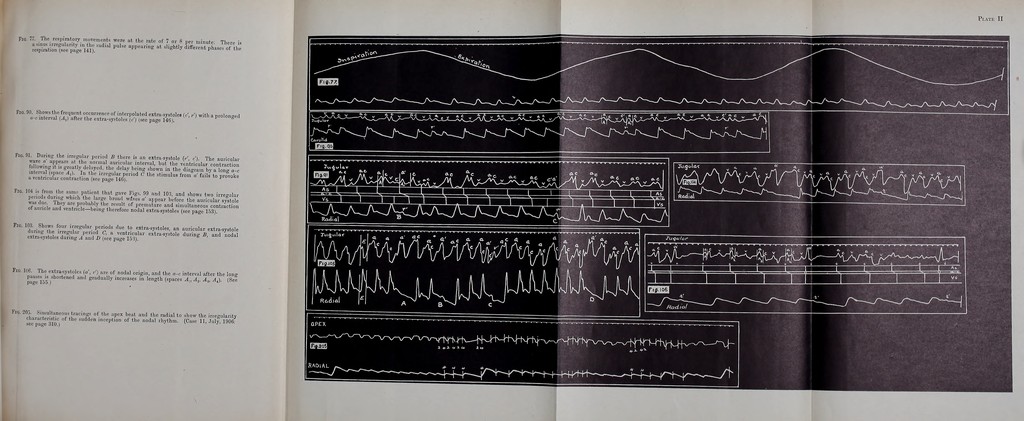
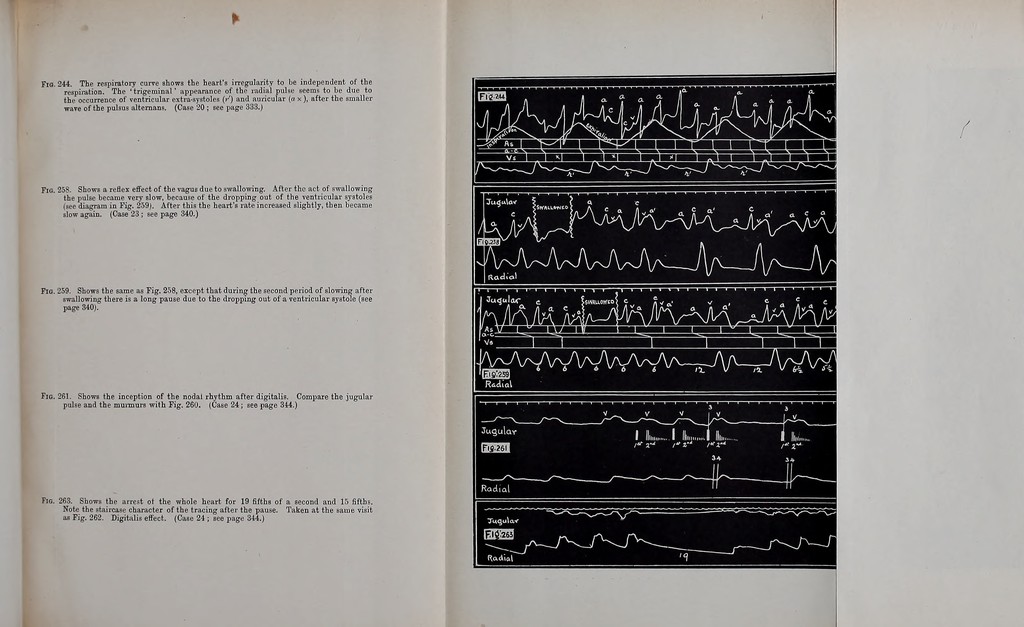
![^^tr^^]^:-^ ''W- sHghtl,li,FerentpLse?oVth': ^^ f■Wri'lff°f™« of interpolated extm-systoles (c, ,■} with a prolonged Fig. 91. During the irregular period B there is an extra-systole (,•', c'). The auricular roW?n.Tt''r:;.^',l*'^? normal aurieular interval, but the Ventricular contractioi inte^al?snV.P^f f -T /i'^'- • >e delay bemg shown in the diagram by a long a-c interval (space A,). In the irregular period C the stimulus from a' fails to provoke a ventncnlar contraction (see page 146). provose '2,trt/T 'r'l .f'',' ^5 3, and shows two irregular periods during which the large broad wilves o' appear before the auricular svstole of auncle and ventricle-bemg therefore nodal extra^systoles (see page 153). 'durin^tTe periods due to extra-systoles, an auricular extra-systole dunng the irregular period C. a ventricular extra-systole during B, and nodal extra-systoles during A and V (see page 153). 1, Ji'i/^h^^r^^'''of.Oiial origin, and the a-c. interval after the long page 155 ) gradually increases in length (spaces A,, A„ A^, A,). (See ^IL ^'°'!'f.°e<'f'--iicings of the apex beat and the radial to show the irregularity charactenstic of the sudden inception of the nodal rhythm. (Case 11, July, 19061 SGS ptlgC OiU.)](https://iiif.wellcomecollection.org/image/b21466002_0385.jp2/full/800%2C/0/default.jpg)