A dictionary of domestic medicine and household surgery / by Spencer Thomson and J.C. Steele.
- Thomson, Spencer, 1848-1883.
- Date:
- 1903
Licence: In copyright
Credit: A dictionary of domestic medicine and household surgery / by Spencer Thomson and J.C. Steele. Source: Wellcome Collection.
44/790 (page 24)
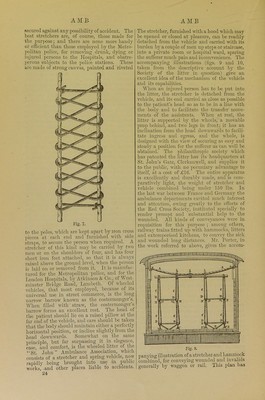
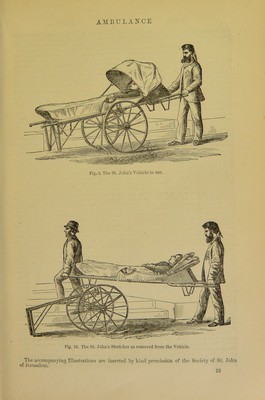
![secured against any possibility of accident. The best stretchers are, of course, those made for the pur] iose; and there are none more handy or efficient than those employed by the Metro- politan police, for removing drunk, dying or injured persons to the Hospitals, and obstre- perous subjects to the police stations. These are made of strong canvas, painted and riveted to the poles, which are kept apart by iron cross pieces at each end and furnished with side straps, to secure the person when required. A stretcher of this kind may be carried by two men or on the shoulders of four, and has four short iron feet attached, so that it is always raised above the ground level, when the person is laid on or removed from it. It is manufac- tured for the Metropolitan police, and for the London Hospitals, by Atkinson & Co., of Wcst- iiiinster Bridge Road, Lambeth. 01 wheeled vehicles, that most employed, because of its universal use in street commerce, is the long narrow barrow known as the costermonger’s. When filled with straw, the costermonger’s baiTOW forms an excellent rest. The head of the patient should lie on a raised pillow at the far end of the vehicle, and care should be taken that the body should maintain either a perfectly horizontal position, or incline slightly from the head downwards. Somewhat on the same principle, but far surpassing it in elegance, ease, and comfort, is the wheeled litter of the “St. John” Ambulance Association, which consists of a stretcher and spring vehicle, now rapidly being brought into use in public works, .and other places liable to accidents. 24- The stretcher, furnished with a hood which may be opened or closed at pleasure, can be readily detached from the vehicle and carried with its burden by a couple of men up steps or staircase, into a private room or hospital ward, sparing the sufferer much pain and inconvenience. The accompanying illustrations (figs. 9 and 10, taken from the descriptive account by the Society of the litter in question) give an excellent idea of the mechanism of the vehicle and its capabilities. When an injured person has to be put into the litter, the stretcher is detached from the vehicle, and its end carried as close as possible to the patient’s head so as to be in a line with the body and to facilitate the transfer' move- ments of the assistants. When at rest, the litter is supported by the wheels, a movable prop behind, and two legs in front; it has an inclination from the licau downwards to facili- tate ingress and egress, and the whole, is designed with the view of securing as easy and steady a position for the sufferer as can well be obtained. The philanthropic society which has patented the litter has its headquarters at St. John’s Gate, Clcrkenwell, and supplies it to the public, with no pecuniary advantage to itself, at a cost of £16. The entire apparatus is excellently and durably made, and is com- paratively light, the weight of stretcher and vehicle combined being under 150 lbs. In the last war between France and Germany the ambulance departments excited much interest and attention, owing greatly to the efforts of the Ked Cross Society, instituted specially to render prompt and substantial help to the wounded. All kinds of conveyances were in requisition for this purpose ; among others, railway trains fitted up with hammocks, litters and extemporised kitchens, to convey the sick and wounded long distances. Mr. Porter, in the work referred to above, gives the accom- panying illustration of a stretcher and hammock combined, for conveying wounded and invalids generally by waggon or rail. This plan has](https://iiif.wellcomecollection.org/image/b28139835_0044.jp2/full/800%2C/0/default.jpg)