Cellular toxins, or, The chemical factors in the causation of disease / by Victor C. Vaughan... and Frederick G. Novy.
- Victor Clarence Vaughan
- Date:
- 1902
Licence: Public Domain Mark
Credit: Cellular toxins, or, The chemical factors in the causation of disease / by Victor C. Vaughan... and Frederick G. Novy. Source: Wellcome Collection.
Provider: This material has been provided by the Augustus C. Long Health Sciences Library at Columbia University and Columbia University Libraries/Information Services, through the Medical Heritage Library. The original may be consulted at the the Augustus C. Long Health Sciences Library at Columbia University and Columbia University.
456/506 page 452
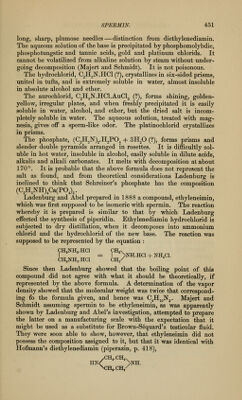
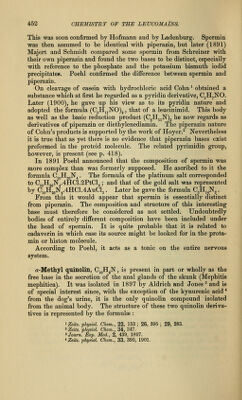
![This was soon confirmed by Hofmann and by Ladenburg. Spermin was then assumed to be identical with piperazin, but later (1891) Majert and Schmidt compared some spermin from Schreiner with their own piperazin and found the two bases to be distinct, especially with reference to the phosphate and the potassium bismuth iodid precipitates. Poehl confirmed the difference between spermin and piperazin. On cleavage of casein with hydrochloric acid Cohn ^ obtained a substance which at first he regarded as a pyridin derivative, CgH^NO. Later (1900), he gave up his view as to its pyridin nature and adopted the formula (CgHjj]SrO)2, that of a leucinimid. This body as well as the basic reduction product (CgHj3N)2 he now regards as derivatives of piperazin or diethylenediamin. The piperazin nature of Cohn's products is supported by the work of Hoyer.^ Nevertheless it is true that as yet there is no evidence that piperazin bases exist preformed in the proteid molecule. The related pyrimidin group, however, is present (see p. 418). In 1891 Poehl announced that the composition of spermin was more complex than was formerly supposed. He ascribed to it the formula CioH2gN4. The formula of the platinum salt corresponded to CjQH2gN^.4E[C1.2PtCl4; and that of the gold salt was represented by CioH2gN,.4HC1.4AuCl3. Later he gave the formula C^Hj^N^. From this it would appear that spermin is essentially distinct from piperazin. The composition and structure of this interesting base must therefore be considered as not settled. Undoubtedly bodies of entirely different composition have been included under the head of spermin. It is quite probable that it is related to cadaverin in which case its source might be looked for in the prota- min or histon molecule. According to Poehl, it acts as a tonic on the entire nervous system. a-Methyl quinolin, Cij^H^N, is present in part or wholly as the free base in the secretion of the anal glands of the skunk (Mephitis mephitica). It was isolated in 1897 by Aldrich and Jones ^ and is of special interest since, with the exception of the kynurenic acid * from the dog's urine, it is the only quinolin compound isolated from the animal body. The structure of these two quinolin deriva- tives is represented by the formulae : ^Zeits. physiol. Chem., 22, 153; 26, 395 ; 29, 283. Zeits. physiol. Chem., 34, 347. ^Journ. Exp. Med., 2, 439, 1897.](https://iiif.wellcomecollection.org/image/b2120505x_0456.jp2/full/800%2C/0/default.jpg)