The action of an active principle from apocynum / by H.H. Dale and P.P. Laidlaw.
- Henry Hallett Dale
- Date:
- [1909?]
Licence: Public Domain Mark
Credit: The action of an active principle from apocynum / by H.H. Dale and P.P. Laidlaw. Source: Wellcome Collection.
8/34
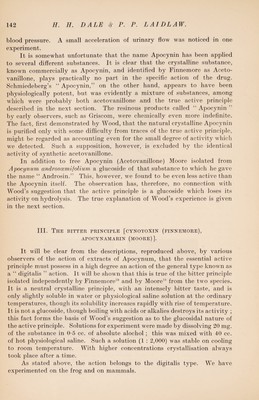
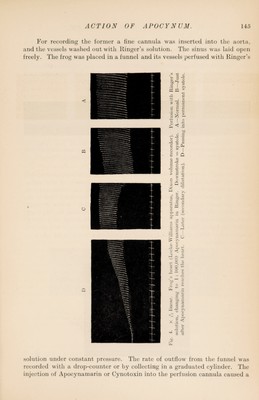
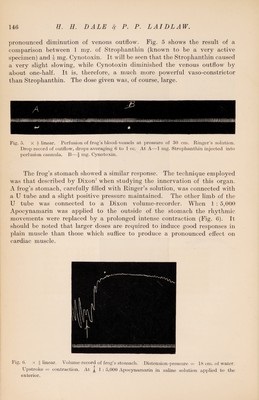
![blood pressure. A small acceleration of urinary flow was noticed in one experiment. It is somewhat unfortunate that the name Apocynin has been applied to several different substances. It is clear that the crystalline substance, known commercially as Apocynin, and identified by Finnemore as Aceto- vanillone, plays practically no part in the specific action of the drug. Schmiedeberg’s “ Apocynin,” on the other hand, appears to have been physiologically potent, but was evidently a mixture of substances, among which were probably both acetovanillone and the true active principle described in the next section. The resinous products called “ Apocynin ” by early observers, such as Griscom, were chemically even more indefinite. The fact, first demonstrated by Wood, that the natural crystalline Apocynin is purified only with some difficulty from traces of the true active principle, might be regarded as accounting even for the small degree of activity which we detected. Such a supposition, however, is excluded by the identical activity of synthetic acetovanillone. In addition to free Apocynin (Acetovanillone) Moore isolated from Apocynum androsoemifolium a glucoside of that substance to which he gave the name “ Androsin.” This, however, wTe found to be even less active than the Apocynin itself. The observation has, therefore, no connection with Wood’s suggestion that the active principle is a glucoside which loses its activity on hydrolysis. The true explanation of Wood’s experience is given in the next section. III. The bitter principle [cynotoxin (finnemore), APOCYNAMARIN (MOORE)]. It will be clear from the descriptions, reproduced above, by various observers of the action of extracts of Apocynum, that the essential active principle must possess in a high degree an action of the general type known as a “ digitalis ” action. It will be shown that this is true of the bitter principle isolated independently by Finnemore10 and by Moore18 from the two species. It is a neutral crystalline principle, with an intensely bitter taste, and is only slightly soluble in water or physiological saline solution at the ordinary temperatures, though its solubility increases rapidly with rise of temperature. It is not a glucoside, though boiling with acids or alkalies destroys its activity ; this fact forms the basis of Wood’s suggestion as to the glucosidal nature of the active principle. Solutions for experiment were made by dissolving 20 mg. of the substance in 0-5 cc. of absolute alochol ; this was mixed with 40 cc. of hot physiological saline. Such a solution (1 : 2,000) was stable on cooling to room temperature. With higher concentrations crystallisation always took place after a time. As stated above, the action belongs to the digitalis type. We have experimented on the frog and on mammals.](https://iiif.wellcomecollection.org/image/b30613280_0008.jp2/full/800%2C/0/default.jpg)