The histories of the Colleges of Physicians and Surgeons, and of the Apothecaries' Company : including the manuscript annals of the London College of Physicians, from 1682 to 1749 : with the editor's plan of medical reform.
- Edwards Crisp
- Date:
- 1851
Licence: Public Domain Mark
Credit: The histories of the Colleges of Physicians and Surgeons, and of the Apothecaries' Company : including the manuscript annals of the London College of Physicians, from 1682 to 1749 : with the editor's plan of medical reform. Source: Wellcome Collection.
Provider: This material has been provided by The Royal College of Surgeons of England. The original may be consulted at The Royal College of Surgeons of England.
27/34 (page 25)
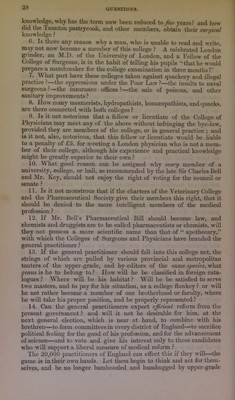
![Sonic plain Quexiions to the General Practitioners oj^ England, and the Editor's Plan of Medical Reform. Before we put the questions wo alluded to in our last number, we must ])lace once more before the reader the outlines of the plan of medical reform we have advocated in the first volume of our journal (p. 30). That a Faculty of Medicine, composed of all the jwactitioners who have obtained diplomas in the United Kingdom, shall be formed in England, Ireland, and Scotland; and that the senate,* council, or governing board of the said faculty, shall be elected by the members of the various universities, colleges, and halls of the three kingdoms ; the graduates of Universities, and the members of the Colleges of Physicians, electing the examiners in medicine and pathology; the melnbers of the Colleges of Surgeons, the examiners in anatomy, physiology, and surgery, and the members of the Apothecaries’ Com- pany (from their own body) ; the examiners in chemistry, materia medica, botany, and midwifery. That the members of the senate, or examining board, shall receive a fixed salary, and shall not be teachers, nor derive any profit from the sale of hospital tickets or lectures. That a preliminary examination in mathematics and classics shall be instituted; and the examiners shall not be members of the medical profession. That the four subsequent examinations—1. In anatomy and physiology; 2. Chemistry, materia medica, botany, and midwifery; 3. Siu-gery; 4. Practice of medicine, pathology, and medical juris- prudence—shall be conducted in public; and shall be open to all legally-qualified practitioners. That the same curricula, and the same price for the diploma, shall be required in the three kingdoms ; and that all who practise medicine and surgery after shall obtain tho degree of doctor of medicine and sm’gcry from the faculty before they are entitled to registration. That the examinations for a few years shall be suited to the acquirements of the students; and that the expense of attendance on lectures and hospitals shall be so regulated by government as not to exclude the student of humble means, who is more likely, if a fair field is open to him, to advance medical science. The reader will naturally ask what will become of the existing cor- porations ? We answer, does their past history demand for them a moment’s consideration ? But to whom does the right belong—to the thousands, or to the units, who have usurped a power for their own aggrandisement, and not for tire good of science ? It will be observed that the establishment of a Faculty of Medicine, according to our plan, does not interfere directly with the vested rights of one of these corpo- rations ; but it gives to every member of university, college, or hall, the privilege of voting for the senate of the faculty in the country • The examiners would form tlie senate, and would be composed of 20 in each country, including the non-medical examiners. They should receive £500. per annum ; and the surplus from diplomas would be amply sulheient for the support of the faculty, including the library and museum.](https://iiif.wellcomecollection.org/image/b22334981_0029.jp2/full/800%2C/0/default.jpg)