Federal register. Part II : proposal for a coordinated framework for regulation of biotechnology : notice. / Office of Science and Technology Policy.
- Office of Science and Technology Policy
- Date:
- 1984
Licence: Public Domain Mark
Credit: Federal register. Part II : proposal for a coordinated framework for regulation of biotechnology : notice. / Office of Science and Technology Policy. Source: Wellcome Collection.
3/56 page 50857
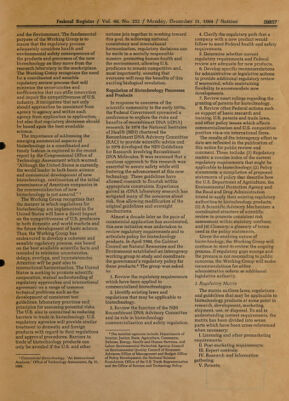
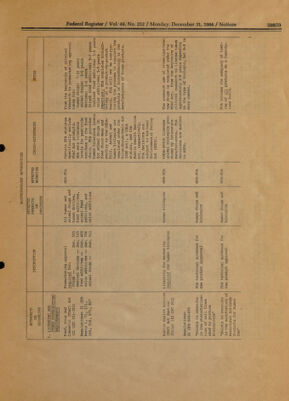
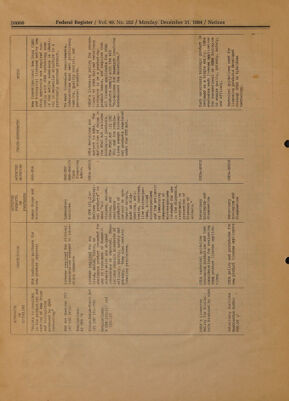
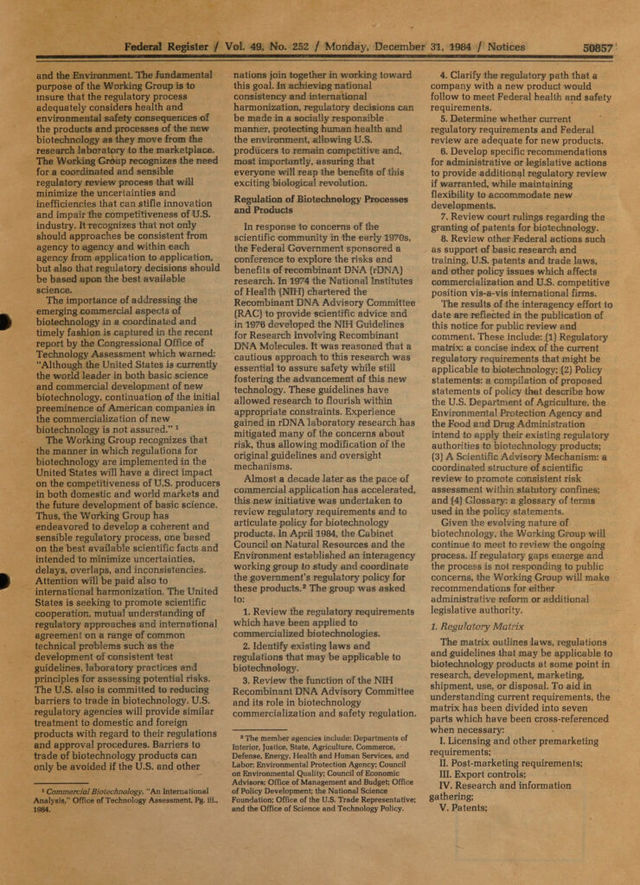
![enviro: ‘safety consequences of the products and processes of the new biotechnology as they move from the research laboratory to the marketplace. - The Working : p recognizes the need for a coordinated and sensible regulatory review process that will minimize the uncertainties and inefficiencies that can stifle innovation and impair the competitiveness of U.S. industry. It recognizes that not only should approaches be consistent from agency to agency and within each agency from application to application, but also that regulatory decisions should be based upon the best available science. _ The importance of addressing the biotechnology in a coordinated and timely fashion is captured in the recent report by the Congressional] Office of Technology Assessment which warned: “Although the United States is currently the world leader in both basic science and commercial] development of new preeminence of American companies in the commercialization ofnew _ biotechnology is not assured.” 4 The Working Group recognizes that the manner in which regulations for biotechnology are implemented in the ~ United States will have a direct impact on the competitiveness of U.S. producers the future development of basic science. Thus, the Working Group has endeavored to develop a coherent and on the best available scientific facts and intended to minimize uncertainties, delays, overlaps, and inconsistencies. _ Attention will be paid also to - international harmonization. The United States is seeking to promote scientific cooperation, mutual understanding of regulatory appreaches and international - agreement on a range of common guidelines, laboratory practices and principles for assessing potential risks. The U.S. also is committed to reducing barriers to trade in biotechnology. U.S. _regulatory agencies will provide similar treatment to domestic and foreign and approval procedures. Barriers to trade of biotechnology products can 1 Commercial Biotechnology, “An International Analysis,” Office of Technology Assessment, Pg. iti., 1964. nations join cme tel in working toward this goal. In achieving national — consistency and international harmonization, regulatory decisions can be made in a socially responsible . manner, protecting human health and the environment, allowing U.S. — producers to remain competitive and, most importantly, assuring that everyone will reap the benefits of this exciting biclogical revolution. Regulation of Biotechnology Processes and Products In response to concerns of the scientific community in the early 1970s, the Federal Government sponscred a conference to explore the risks and benefits of recombinant DNA (rDNA) research. In 1974 the National Institutes of Health (NIH) chartered the Recombinant DNA Advisory Commitiee (RAC) to provide scientific advice and in 1976 developed the NIH Guidelines for Research Involving Recombinant DNA Molecules. It was reasoned that a cautious approach te this research was essential to assure safety while stiil fostering the advancement of this new technology. These guidelines have allowed research to flourish within appropriate constraints. Experience gained in rDNA laboratory research has mitigated many of the concerns about risk, thus allowing modification of the original guidelines and oversight mechanisms. Almost a decade later as the pace of commercial application has accelerated, this new initiative was undertaken to review regulatory requirements and to articulate-policy for biotechnolegy products. In April 1984, the Cabinet Council en Natural Resources and the Environment established an interagency working group to study and coordinate the government's regulatory policy for these products.? The group was asked, to: 1. Review the regulatory requirements which have been applied to commercialized biotechnologies. 2. Identify existing laws and biotechnology. 3. Review the function of the NIH Recombinant DNA Advisory Committee and its role in biotechnology 2 The member agencies include: Departments of Interior, Justice, State, Agriculture, Commerce, - Defense, Energy, Health and Human Services, and Labor; Environmental Protection Agency; Council Advisors; Office of Management and Budget; Office of Policy Development; the National Science Foundation; Office of the U.S. Trade Representative; and the Office of Science and Technology Policy. 4. Clarify the regulatory path that a company with a new product would follow to meet Federal health and safety requirements. 5. Determine whether current regulatory requirements and Federal review are adequate for new products. 6. Develop specific recommendations for administrative or legislative actions to provide additional regulatory review if warranted, while maintaining flexibility to accommodate new developments. 7. Review court rulings regarding the granting of patents for biotechnology. 8. Review other Federal actions such training, U.S. patents and trade laws, and other policy issues which affects commercialization and U.S. competitive position vis-a-vis international firms. The results of the interagency effort to date are reflected in the publication of this notice for public review and comment. These include: (1) Regulatory matrix: a concise index of the current regulatory requirements that might be applicable to biotechnology; (2) Policy statements: a compilation of proposed statements of policy that describe how the U.S. Department of Agriculture, the Environmental Protection Agency and the Food and Drug Administration intend to apply their existing regulatory authorities to biotechnology products; (3) A Scientific Advisory Mechanism: a coordinated structure of scientific review to promote consistent risk assessment within statutory confines; and (4) Glossary: a glossary of terms used in the policy statements. Given the evolving nature of biotechnology, the Wor rking Group will continue to meet to review the ongoing process. if regulatory gaps emerge and the process is not responding to public concerns, the Working Group will make recommendations for either administrative reform or additional legislative authority. 1. Regulatory Matrix The matrix outlines laws, regulations and guidelines that may be applicable to biotechnology products at some point in research, development, marketing, shipment, use, or disposal. To aid in understanding current requirements, the matrix has been divided into seven parts which have been cross-referenced when necessary: I, Licensing and other Piemarkstne requirements; Il. Post-marketing requirements; II. Export controls; IV. Research and information gathering; V. Patents;](https://iiif.wellcomecollection.org/image/b32230308_0003.jp2/full/800%2C/0/default.jpg)


 No text description is available for this image
 No text description is available for this image
 No text description is available for this image