Kirkes' handbook of physiology / by W. Morrant Baker and Vincent Dormer Harris.
- William Senhouse Kirkes
- Date:
- 1900
Licence: In copyright
Credit: Kirkes' handbook of physiology / by W. Morrant Baker and Vincent Dormer Harris. Source: Wellcome Collection.
34/874
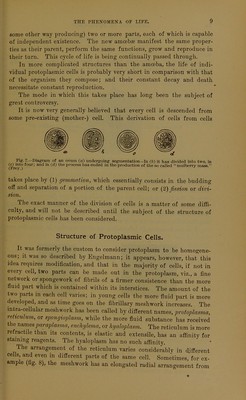
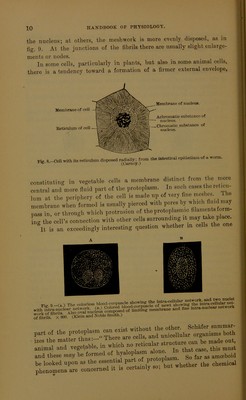
![the nucleus; at others, the meshwork is more evenly disposed, as in fig. 9. At the junctions of the fibrils there are usually slight enlarge- ments or nodes. In some cells, particularly in plants, but also in some animal cells, there is a tendency toward a formation of a firmer external envelope, Membrane of cell Reticulum of cell Membrane of nucleus. Achromatic substance of nucleus. ....Chromatic substance of nucleus. g —Cell with its reticulum disposed radially; from the intestinal epithelium of a worm. * (Carnoy.) constituting in vegetable cells a membrane distinct from the moie central and more fluid part of the protoplasm. In such cases the reticu- lum at the periphery of the cell is made up of very fine meshes. The membrane when formed is usually pierced with pores by which fluid may pass in, or through which protrusion of the protoplasmic filaments form- ing the cell’s connection with other cells surrounding it may take place. SIt is an exceedingly interesting question whether m cells the one m WMW ill? Fig 9 -(a.) The colorless blood-corpuscleRowing• “ “4 “ 'anTmV a“d vegetable, in which n0 and these may be formed of iya 05>, top]asmt So far as amoeboid be looked upon as the essen la pai P whether the chemical phenomena are concerned it is certainly so, but whether](https://iiif.wellcomecollection.org/image/b28131654_0036.jp2/full/800%2C/0/default.jpg)



 No text description is available for this image
 No text description is available for this image
 No text description is available for this image