The histology and histochemistry of man : a treatise on the elements of composition and structure of the human body / by Heinrich Frey ... Translated from the fourth German edition, by Arthur E.J. Barker ... and revised by the author. With six hundred and eight engravings on wood.
- Heinrich Frey
- Date:
- 1874
Licence: Public Domain Mark
Credit: The histology and histochemistry of man : a treatise on the elements of composition and structure of the human body / by Heinrich Frey ... Translated from the fourth German edition, by Arthur E.J. Barker ... and revised by the author. With six hundred and eight engravings on wood. Source: Wellcome Collection.
Provider: This material has been provided by King’s College London. The original may be consulted at King’s College London.
47/698 page 35
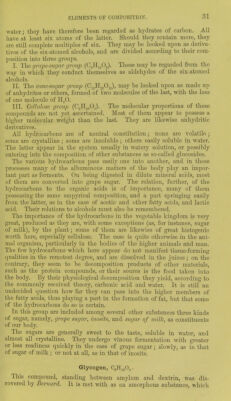
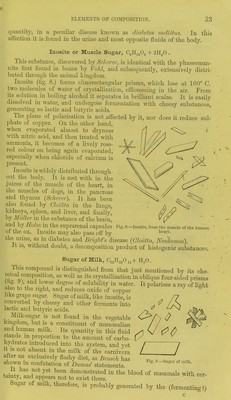
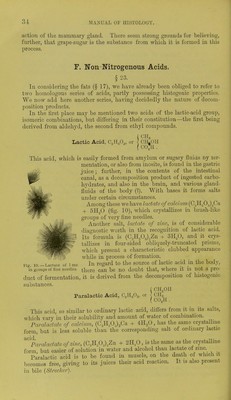
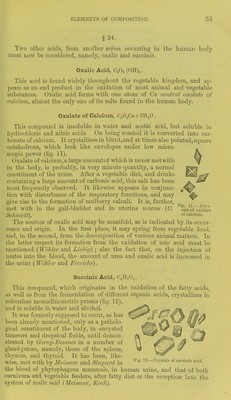
![§24. Two other acids, from another series occurring in the human body must now be considered, namely, oxalic and succinic. Oxalic Acid, C202 (OH)2. This acid is found widely throughout the vegetable kingdom, and ap- pears as an end product in the oxidation of most animal and vegetable substances. Oxalic acid forms with one atom of Ca neutral oxalate of calcium, almost the only one of its salts found in the human body. Oxalate of Calcium, C204Ca + 3I-].,0. This compound is insoluble in water and acetic acid, but soluble in hydrochloric and nitric acids. On being roasted it is converted into car- bonate of calcium. It crystallises in blunt, and at times also pointed, scpiare octahedrons, which look like envelopes under low micro- scopic power (fig. 11). Oxalate of calcium, a large amountof which is never met with in the body, is probably, in very minute quantity, a normal constituent of the urine. After a vegetable diet, and drinks containing a large amount of carbonic acid, this salt has been most frequently observed. It likewise appears in conjunc- tion with disturbance of the respiratory functions, and may give rise to the formation of mulberry calculi. It is, further, met with in the gall-bladder and in uterine mucus (C. 1 'tau^fTxainie Schmidt). of calcium. The sources of oxalic acid may be manifold, as is indicated by its occur- rence and origin. In the first place, it may spring from vegetable food, and, in the second, from the decomposition of various animal matters. In the latter respect its formation from the oxidation of uric acid must be mentioned (Wohler and Liebig); also the fact that, on the injection of urates into the blood, the amount of urea and oxalic acid is increased in the urine (Wohler and Frerichs). Succinic Acid, C.,Hc04. This compound, which originates in the oxidation of the fatty acids, as well as from the fermentation of different organic acids, crystallizes in colourless monoclinometric prisms (fig. 12), and is soluble in water and alcohol. It was formerly supposed to occur, as has been already mentioned, only as a patholo- gical constituent of the body, in encysted tumours and dropsical fluids, until demon- strated by Gorup-Besanez in a number of gland-juices, namely, those of the spleen, thymus, and thyroid. It has been, like- wise, met with by Meissner and Shepard in l'l&' 12-_Crystals of succinic acid, the blood of phytophagous mammals, in human urine, and that of both carnivora and vegetable feeders, after fatty diet or the reception into the system of malic acid (Meissner, Koch).](https://iiif.wellcomecollection.org/image/b21310178_0047.jp2/full/800%2C/0/default.jpg)