The histology and histochemistry of man : a treatise on the elements of composition and structure of the human body / by Heinrich Frey ... Translated from the fourth German edition, by Arthur E.J. Barker ... and revised by the author. With six hundred and eight engravings on wood.
- Heinrich Frey
- Date:
- 1874
Licence: Public Domain Mark
Credit: The histology and histochemistry of man : a treatise on the elements of composition and structure of the human body / by Heinrich Frey ... Translated from the fourth German edition, by Arthur E.J. Barker ... and revised by the author. With six hundred and eight engravings on wood. Source: Wellcome Collection.
Provider: This material has been provided by King’s College London. The original may be consulted at King’s College London.
48/698 page 36
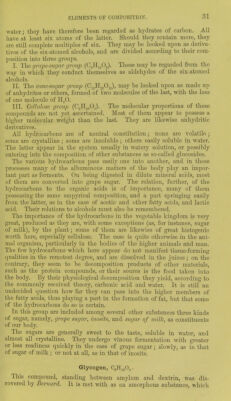
![Carbolic Acid or Phenol, CaII80. The sources of this compound are manifold, as, for instance, the distil- lation of many organic substances and the oxidation of glue, also, which produces it in traces only. It possesses poisonous properties for the human body. It has been obtained from human and mammalian urine (Staedeler), and met with also in the same after reception into the stomach of benzol (Sclvulzen and Naunyn). Taurylic Acid or Taurol, C7I180. This second compound, allied to the last, has been obtained from the same fluids, but not as yet in a pure state {Staedeler). It is, perhaps, identical with kressol discovered later. G-. Nitrogenous Animal Acids. §25. Although from organic chemistry we have learned how to produce a whole series of nitrogenous acids artificially, in a manner reminding us of the alkaloids, the number of such compounds occurring naturally in the human body is very limited, and none of them have up to the present been composed by art. They are not found in the vegetable kingdom at all. None of these substances possess histogenic properties; all are—and in this respect they resemble animal bases—mutation products of histogenic matters or plastic alimentary materials. Owing to their complex constitu- tion they give rise, under certain circumstances, to chemically interesting mutations. If we except two less known acids which are met with in muscle and sweat, they are either constituents of the urine or the bile, forming essential elements of these secretions. Inosinic Acid, C]0H14N4Ou. This is a non-crystallizable acid, met with in the form of a syrupy fluid, whose constitu- tion is not yet quite certain. It is a constituent of muscle-juice, and as such probably a muta- tion product of the fleshy fibre. Hydrotinic Acid. This is likewise a syrupy acid, recognised by Fame as a constituent of human sweat. Uric Acid, C5H4N403. This bibasic acid, a derivative of ammonia, and of unknown constitution, appears to the unaided eye as a white powdery or scaly substance. Under the microscope the greatest variety in crystalline form may be seen in uric acid. By the splitting up of the salts of uric acid we obtain rhombic tables, or six-sided plates (fig. 13, «, a, a) resembling cystin. Precipitated very slowly, uric acid forms elongated right-angled tables, or parallelopipedic figures, or even right-angled, four-sided prisms with straight ends. The latter are often Fig. 13.—Uric acid in its various crys- talline forms, a, a, a, crystals such as are met with on the decomposi- tion of urates; 6, crystalline forms from human urine; c, dumb-bell crystals.](https://iiif.wellcomecollection.org/image/b21310178_0048.jp2/full/800%2C/0/default.jpg)


 No text description is available for this image
 No text description is available for this image
 No text description is available for this image