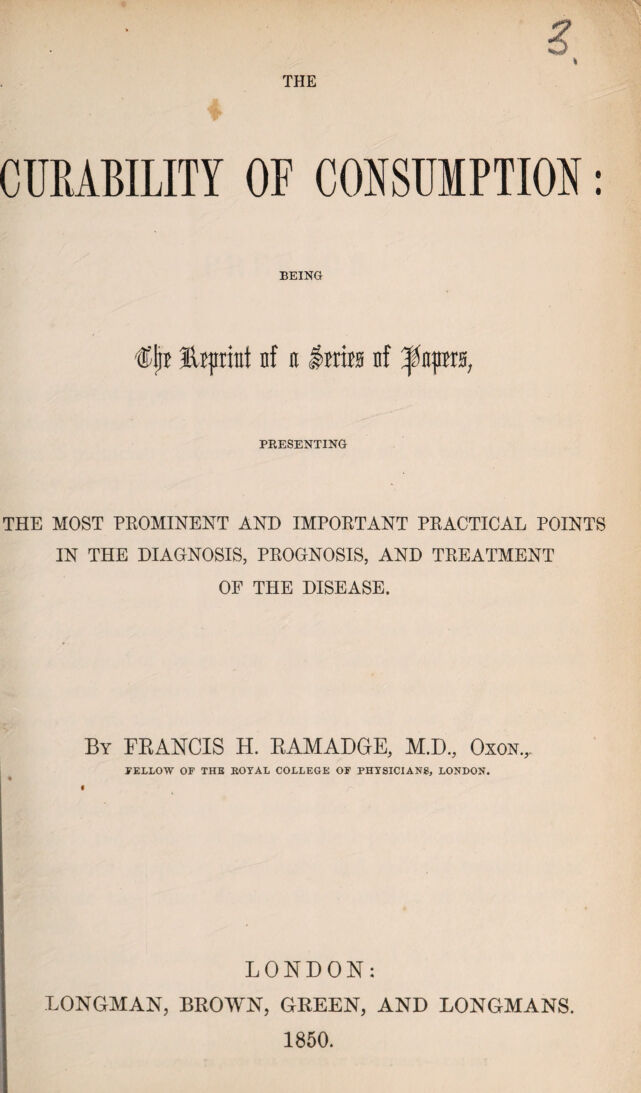
The curability of consumption: being the reprint of a series of papers, presenting the most prominent and important practical points in the diagnosis, prognosis, and treatment of the disease / [Francis Hopkins Ramadge].
- Francis Hopkins Ramadge
- Date:
- 1850
Licence: Public Domain Mark
Credit: The curability of consumption: being the reprint of a series of papers, presenting the most prominent and important practical points in the diagnosis, prognosis, and treatment of the disease / [Francis Hopkins Ramadge]. Source: Wellcome Collection.
5/64
![THE CURABILITY OE CONSUMPTION. [Reprinted from the Medical Times, August 27,1842.] The misunderstanding and obscurity which so long prevailed respecting the nature and treatment of phthisis gave rise to a popular notion, which amounted almost to a superstition— entertained even by some professional men of eminence—that this disease, when once developed, was incurable, and that the victims it assailed were predestined to sink into an early and premature grave. This gloomy prognosis threw a cloud over the happiness and prospects of every family doomed to contend with so grievous an affliction; nay, the case was looked on as one inevitably distressing; for, the disease being pronounced here¬ ditary, it was considered to be entailed upon generation after generation. Happily, the progress of Medical Science has done much to dispel this delusion; inasmuch as it has been proved by evidence the most irrefragable and conclusive, that con¬ sumption, even in its advanced stages, may be arrested in its progress, and cured with as much certainty as any other disease incident to humanity. Many years ago the illustrious Laennec published cases showing that Nature effected a curative process in the lungs by the cicatrization even of extensive tubercular cavities;—hence he came to the conclusion, that “ patients may recover after having had in their lungs tubercles which became softened and formed ulcerous cavities.” He states, that on the shores of the Bay of Douarnenez, his native place, whither he himself retired in a state of latent phthisis, one-half of the con¬ sumptive cases were cured. Unhappily for science, this great man was cut off prematurely by the very disease he had studied so profoundly.](https://iiif.wellcomecollection.org/image/b3187731x_0005.jp2/full/800%2C/0/default.jpg)