Observations on the condition of the body after death from cholera / By Wm. Frederick Barlow.
- Barlow, W. F. (William Frederick), 1817-1853
- Date:
- 1850
Licence: Public Domain Mark
Credit: Observations on the condition of the body after death from cholera / By Wm. Frederick Barlow. Source: Wellcome Collection.
Provider: This material has been provided by London School of Hygiene & Tropical Medicine Library & Archives Service. The original may be consulted at London School of Hygiene & Tropical Medicine Library & Archives Service.
15/28 (page 13)
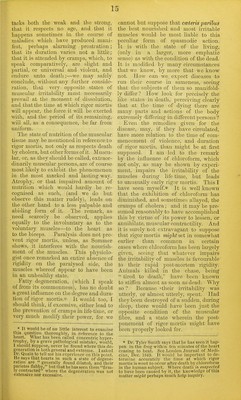
![The temperature was taken soon aftei- death ; but the time vaiied, as the reader may see by turning to the ac- count. Sometimes an hour, or two hours, or more, elapsed before the ther- mometer was used. The decline of heat was frequently noticed up to a certain point. In many of the instances mus- cular conti'actillty was readily made manifest by mechanical irritation of the muscles. The comimrative temperatm-e of life and death does not appear to have been fully and accurately esti- mated ; but the subject is alluded to, and it is stated that the body of a Phila- delphian, which before death had been remarkably cold, had a tempera- ture after death as high as 109°.'' The thermometer was, in one case, applied to the chest; in another, to the axiUa; but, for the most part, we are left to guess with what spot it was placed in contact. It woidd, however, seem that the skin was always tested, for notking is said any wliere of the temperature of the internal parts. But of what dis- eases did the subjects of the observations die? The great majority appear to have perished of yeUow fever. The great heat observed in the dead by Dr. Dowler reminds one of the high temperatm-e observed in birds in life- time. The following is Tiedcmanu's table representing the latter; and I in- troduce it that the reader may at once compaj-e it with the imperfect one I have consti'ucted with Dr. Dowler's ex- amples :—• Degrees. Great titmouse . . . 11125 Swallow ..... 111-25 Fingilla, different species 111-25 to 107 Anas, different species . Ill to 106 Common hen .... 109-94 to 102-99 Falco, different species . 109-74 to 104-5 Pigeon 109-58 to 106-7 Eaven 109-23 to 105 99 Pullen 107-49 Common cock .... 103-78 to 102-99 White game .... 102 Gull 100 A very high temperature has been de- monstrated in the human body dumig life. Even the higliest ascribed to birds by Tiedemann, or the highest shown to exist in man, when dead, by Dr. Dowler, has been exceeded by the living fi-ame. Let me aUude to a re- markable case or two. The tempera- ture of 106° has been noticed in scarla- tina by Dr. Dunglison; tliat of 110-75° in tetanus, by Dr. Prevost, of Geneva, who communicated the fact to Dr. W. F. Edwards.* M. Piorry is said to have remarked the temperature of 113° in typhoid fever; but a still higher heat, if observed in the living body,f would, I think, be less calculated to sur- prise us than the amoxmt of warmth which has been already shown to have ha]5pened in the dead. In life-time the balance between the processes whereby the frame is cooled and heated may be altered in vai'ioua ways. Much may happen to favoiu- those chemical changes whereupon animal heat more immediately depends, wliilst, simulta- neously, the secretion of the skin may be so checked that the surface shall ope- rate most imjjerfectly as a diminisher and regulator of the wai-mth of the body. All parts of the subject need well tracing out, though there be writ- ings,—and I may refer to the Memoir of M. Roger on the Temperatme of Infants and Young Children,—in which the pa- thology of animal heat has been han- dled with no little ability and care. The subject, in reference to the nervous sys- tem, is of singular interest. Facts have come to light in reference to injuries of the spinal cord which compel even the attention of the incmious. M. Chossat found by expeiiment that division of the superior portion of this organ was the cause of a remai'kable elevation of heat. Su Benjamin Brodie noticed the temperature of 111°, both during life and directly after death, in a case of forcible sej)aration of the fifth and sixth cervical vertebrae, giving rise to paraly- sis.! Dr. Gull lately infoi-med me of an example of unusually high temperature succeeding to, and, no doubt, indu-ectly caused by, inj uiy of the spine. Diffe- rent parts of the body should, of com-se, be carefully tested by the thermometer in cases of this land. Only lately T saw a man with liis lower extremities en- tirely, liis upper partially, pai-alysed by a large effusion of blood external to the * See On the Influence of Physical Agents oa Life. By. W. F. Edwards, M.D., F.R.S. Trans- lated by Dr. Hod^kin and Dr. Fisher. See p. 257. t It has been stated by Dr. Granville that the heat of the uterus has, during labour, risen so hie-h as 120°. ^ I have made experiments similar to those of M. Chossat, and have met with similar results. 1 have also seen several cases in which an acci- dental injury of the spinal cord has produced the same clTect.—See Sir Benjamin Brodic'.sObser- vations on Injuries of the Spinal Cord, Medico- Chirurgical Transactions, vol. xx.](https://iiif.wellcomecollection.org/image/b21364734_0015.jp2/full/800%2C/0/default.jpg)