Information society : agenda for action in the UK : evidence received after 31 March 1996 / Select Committee on Science and Technology.
- Great Britain. Parliament. House of Lords. Science and Technology Committee.
- Date:
- 1996
Licence: Open Government Licence
Credit: Information society : agenda for action in the UK : evidence received after 31 March 1996 / Select Committee on Science and Technology. Source: Wellcome Collection.
12/324 page 314
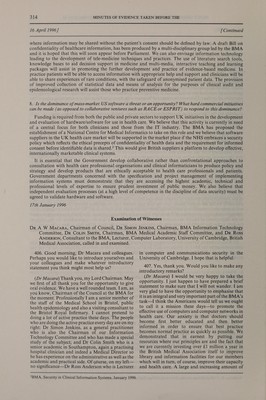
![16 April 1996] [ Continued where information may be shared without the patient’s consent should be defined by law. A draft Bill on confidentiality of healthcare information, has been produced by a multi-disciplinary group led by the BMA and it is hoped that this will soon appear before Parliament. We can also envisage information technology leading to the development of tele-medicine techniques and practices. The use of literature search tools, knowledge bases to aid decision support in medicine and multi-media, interactive teaching and learning packages will assist in promoting the further development and practice of evidence-based medicine. In practice patients will be able to access information with appropriate help and support and clinicians will be able to share experiences of rare conditions, with the safeguard of anonymised patient data. The provision of improved collection of statistical data and means of analysis for the purposes of clinical audit and epidemiological research will assist those who practice preventive medicine. 8. Is the dominance of mass-market US software a threat or an opportunity? What hard commercial initiatives can be made (as opposed to collaborative ventures such as RACE or ESPRIT) to respond to this dominance? Funding is required from both the public and private sectors to support UK initiatives in the development and evaluation of hardware/software for use in health care. We believe that this activity is currently in need of a central focus for both clinicians and those from the IT industry. The BMA has proposed the establishment of a National Centre for Medical Informatics to take on this role and we believe that software suppliers in the UK health care market will be supported in the market place if the NHS embraces a security policy which reflects the ethical precepts of confidentiality of health data and the requirement for informed consent before identifiable data is shared.” This would give British suppliers a platform to sen effective, internationally marketable clinical systems. It is essential that the Government develop collaborative rather than confrontational approaches to consultation with health care professional organisations and clinical informaticians to produce policy and strategy and develop products that are ethically acceptable to health care professionals and patients. Government departments concerned with the specification and project management of implementing information systems must demonstrate that they are accessing the highest academic, technical and professional levels of expertise to ensure prudent investment of public money. We also believe that independent evaluation processes (at a high level of competence in the discipline of data security) must be agreed to validate hardware and software. 17th January 1996 Examination of Witnesses Dr A W Macara, Chairman of Council, Dk SIMON JENKINS, Chairman, BMA Information Technology Committee, DR CoLin SmiTH, Chairman, BMA Medical Academic Staff Committee, and Dr Ross ANDERSON, Consultant to the BMA, Lecturer, Computer Laboratory, University of Cambridge, British Medical Association, called in and examined. 406. Good morning, Dr Macara and colleagues. Perhaps you would like to introduce yourselves and your colleagues and make whatever introductory statement you think might most help us? (Dr Macara) Thank you, my Lord Chairman. May we first of all thank you for the opportunity to give oral evidence. We have a well rounded team. I am, as you know, Chairman of the Council at the BMA for the moment. Professionally I am a senior member of the staff of the Medical School in Bristol, public health epidemiology and also a visiting consultant to the Bristol Royal Infirmary. I cannot pretend to doing a lot of active practice these days. The people who are doing the active practice every day are on my right: Dr Simon Jenkins, as a general practitioner who is also the Chairman of our Information Technology Committee and who has made a special study of the subject; and Dr Colin Smith who is a senior academic in Southampton, again a practising hospital clinician and indeed a Medical Director so he has experience on the administrative as well as the academic and practical side. Of course, on my left— no significance—Dr Ross Anderson who is Lecturer in computer and communications security in the University of Cambridge. I hope that is helpful. 407. Yes, thank you. Would you like to make any introductory remarks? (Dr Macara) 1 would be very happy to take the opportunity. I just happen to have prepared a brief statement to make sure that I will not wander. I am very glad to have the opportunity to emphasise that it is an integral and very important part of the BMA’s task—I think the Americans would tell us we ought to call it a mission these days—to promote the effective use of computers and computer networks in health care. Our anxiety is that doctors should become first better educated and then better informed in order to ensure that best practice becomes normal practice as quickly as possible. We demonstrated that in earnest by putting our resources where our principles are and the fact that we are currently investing over £1 million a year in the British Medical Association itself to improve library and information facilities for our members which will in turn, of course, improve their capacity and health care. A large and increasing amount of](https://iiif.wellcomecollection.org/image/b32218631_0012.jp2/full/800%2C/0/default.jpg)