Elements of physiological psychology : a treatise of the activities and nature of the mind from the physical and experimental points of view (thoroughly rev. and re-written) / by George Trumball Ladd and Robert Sessions Woodworth.
- George Trumbull Ladd
- Date:
- 1911
Licence: In copyright
Credit: Elements of physiological psychology : a treatise of the activities and nature of the mind from the physical and experimental points of view (thoroughly rev. and re-written) / by George Trumball Ladd and Robert Sessions Woodworth. Source: Wellcome Collection.
21/740
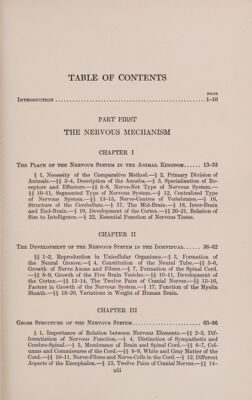
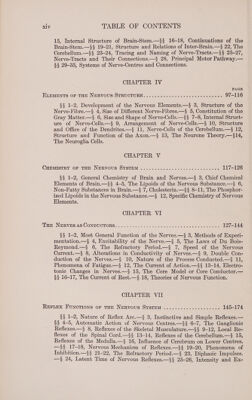
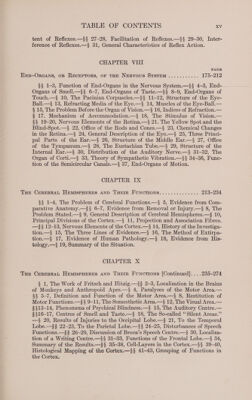
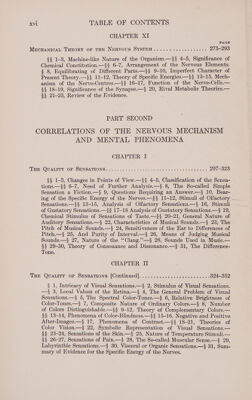
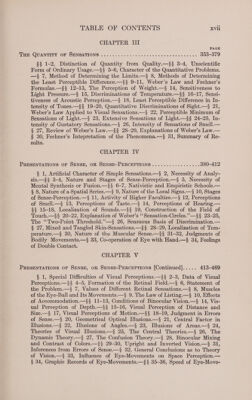
![tent of Reflexes.—§§ 27-28, Facilitation of Reflexes.—§§ 29-30, Inter- ference of Reflexes.—§ 31, General Characteristics of Reflex Action. CHAPTER VIII PAGE Enp-ORGANS, OR RECEPTORS, OF THE NERVOUS SYSTEM ........... 175-212 §§ 1-3, Function of End-Organs in the Nervous System.—§§ 4-5, End- Organs of Smell.—§$§ 6-7, End-Organs of Taste.—§§ 8-9, End-Organs of Touch.—§ 10, The Pacinian Corpuscles.—§§ 11-12, Structure of the Eye- Ball.—§ 13, Refracting Media of the Eye.—§ 14, Muscles of the Eye-Ball.— § 15, The Problem Before the Organ of Vision.—§ 16, Indices of Refraction.— § 17. Mechanism of Accommodation.—§ 18, The Stimulus of Vision.— §§ 19-20, Nervous Elements of the Retina.—§ 21. The Yellow Spot and the Blind-Spot.—§ 22, Office of the Rods and Cones.—§ 23, Chemical Changes in the Retina.—§ 24, General Description of the Eye.—§ 25, Three Princi- pal Parts of the Ear.—§ 26, Structure of the Middle Ear.—§ 27, Office of the Tympanum.—$ 28, The Eustachian Tube.—§ 29, Structure of the Internal Ear.—§ 30, Distribution of the Auditory Nerve.—§ 31-32, The Organ of Corti.—§ 33, Theory of Sympathetic Vibration.—§§ 34-36, Func- tion of the Semicircular Canals.—§ 37, End-Organs of Motion. CHAPTER IX Tur CEREBRAL HEMISPHERES AND THEIR FUNCTIONS............-. 213-234 §§ 1-4, The Problem of Cerebral Functions.—§ 5, Evidence from Com- parative Anatomy.—§§ 6-7, Evidence from Removal or Injury.—§ 8, The Problem Stated.—§ 9, General Description of Cerebral Hemispheres.—$§ 10, Principal Divisions of the Cortex.—§ 11, Projection and Association Fibres. —§§ 12-13, Nervous Elements of the Cortex.—§ 14, History of the Investiga- tion.—§ 15, The Three Lines of Evidence.—§ 16, The Method of Extirpa- tion.—§ 17, Evidence of Human Pathology.—§ 18, Evidence from His- tology.—§ 19, Summary of the Situation. CHAPTER X Tue CEREBRAL HEMISPHERES AND THEIR Funcrions [Continued]... .235-274 § 1, The Work of Fritsch and Hitzig.—§§ 2-3, Localization in the Brains of Monkeys and Anthropoid Apes.—§ 4, Paralyses of the Motor Area.— §§ 5-7, Definition and Function of the Motor Area.—§ 8, Restitution of Motor Functions.—$§ § 9-11, The Somesthetic Area.—§ 12, The Visual Area.— §§13-14, Phenomena of Psychical Blindness.—§ 15, The Auditory Centre.— §§16-17, Centres of Smell and Taste.—§ 18, The So-called “Silent Areas.” —§ 20, Results of Injuries to the Occipital Lobe.—§ 21, To the Temporal Lobe.—$§§ 22-23, To the Parietal Lobe.—§§ 24-25, Disturbances of Speech Functions.—§§ 26-29, Discussion of Broca’s Speech Centre.—§ 30, Localiza- tion of a Writing Centre.—§§ 31-33, Functions of the Frontal Lobe.—§ 34, Summary of the Results.—§§ 35-38, Cell-Layers in the Cortex.—§§ 39-40, Histological Mapping of the Cortex.—§§ 41-43, Grouping of Functions in the Cortex.](https://iiif.wellcomecollection.org/image/b3275467x_0021.jp2/full/800%2C/0/default.jpg)