The electrolysis of organic compounds : Papers / by Hermann Kolbe (1845-1868).
- Adolph Wilhelm Hermann Kolbe
- Date:
- 1900
Licence: In copyright
Credit: The electrolysis of organic compounds : Papers / by Hermann Kolbe (1845-1868). Source: Wellcome Collection.
Provider: This material has been provided by UCL Library Services. The original may be consulted at UCL (University College London)
10/64 page 6
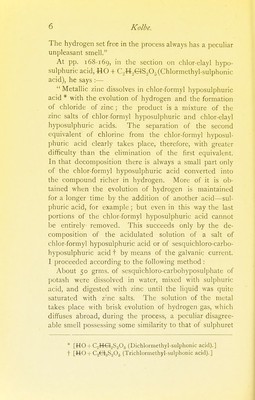
![The hydrogen set free in the process always has a peculiar unpleasant smell. At pp. 168-169, in the section on chlor-elayl hypo- sulphuric acid, HO + C2H2€iS205(Chlormethyl-suIphonic acid), he says :— Metallic zinc dissolves in chlor-formyl hyposulphuric acid * with the evolution of hydrogen and the formation of chloride of zinc; the product is a mixture of the zinc salts of chlor-formyl hyposulphuric and chlor-elayl hyposulphuric acids. The separation of the second equivalent of chlorine from the chlor-formyl hyposul- phuric acid clearly takes place, therefore, with greater difficulty than the elimination of the first equivalent. In that decomposition there is always a small part only of the chlor-formyl hyposulphuric acid converted into the compound richer in hydrogen. More of it is ob- tained when the evolution of hydrogen is maintained for a longer time by the addition of another acid—sul- phuric acid, for example; but even in this way the last portions of the chlor-formyl hyposulphuric acid cannot be entirely removed. This succeeds only by the de- composition of the acidulated solution of a salt of chlor-formyl hyposulphuric acid or of sesquichloro-carbo- hyposulphuric acid t by means of the galvanic current. I proceeded according to the following method : About 50 grms. of sesquichloro-carbohyposulphate of potash were dissolved in water, mixed with sulphuric acid, and digested with zinc until the liquid was quite saturated with zinc salts. The solution of the metal takes place with brisk evolution of hydrogen gas, which diffuses abroad, during the process, a peculiar disagree- able smell possessing some similarity to that of sulphuret * [HO + CoH€loS206 (Dichlormethyl-sulphonic acid).] 1 [«0-I-CoeiaSodo (Triclilormethyl-sulphonic acid).]](https://iiif.wellcomecollection.org/image/b21687730_0010.jp2/full/800%2C/0/default.jpg)