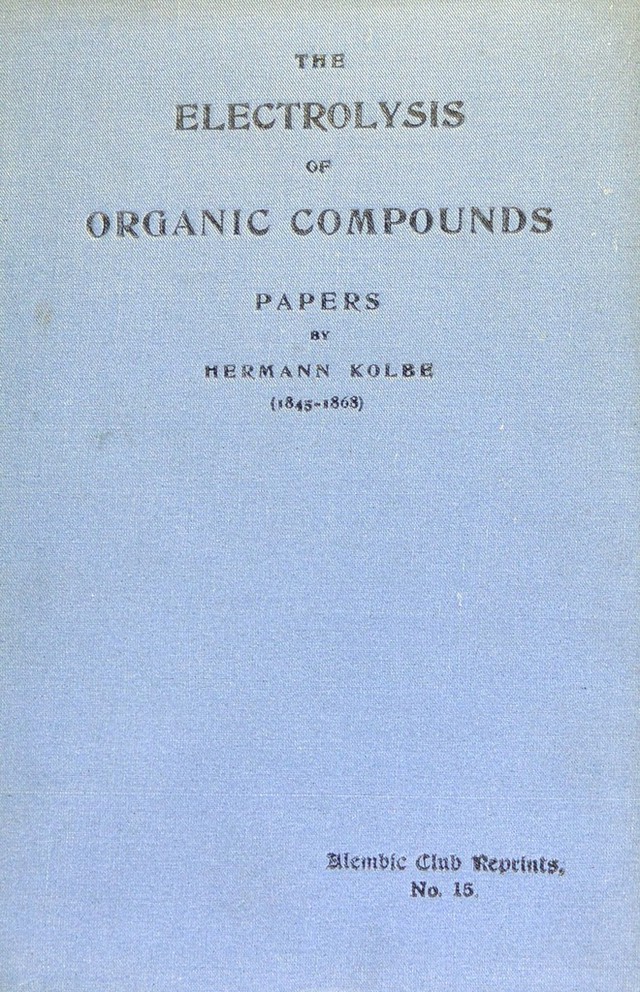
The electrolysis of organic compounds : Papers / by Hermann Kolbe (1845-1868).
- Adolph Wilhelm Hermann Kolbe
- Date:
- 1900
Licence: In copyright
Credit: The electrolysis of organic compounds : Papers / by Hermann Kolbe (1845-1868). Source: Wellcome Collection.
Provider: This material has been provided by UCL Library Services. The original may be consulted at UCL (University College London)
21/64 page 17
![RESEARCHES ON THE ELECTROLYSIS OF ORGANIC COMPOUNDS* HE following investigation has chiefly arisen from JL some former observations! respecting the trans- formations of chloro-carbo-hyposulphuric acid, hydro- chloric acid, and several other substances under the influence of oxygen, when liberated in the circuit of the galvanic current. J The facility with which, particularly the former acid, resisting in the moist way the most powerful oxidizing processes, is decomposed under these circumstances, appears to point to electrolysed oxygen as one of the most valuable oxidizing agents which are at the disposal of the chemist. Its application in chemical decompositions acquires additional importance, since its intensity may be varied, either by concentrating and * [From The Quarterly Journal of the Chemical Society of London, Vol. 2 (1850), pp. 157-184.] t Observations on the oxydizing action of oxygen when dis- engaged by means of voltaic electricity in the Memoirs and Pro- ceedings of the Chemical Society, vol. m. p. 285. % In the above cited investigation it was intended to state, that in the oxidation of hydrochloric acid by means of the electrical current, chloric acid appears at the positive pole even without the presence of an alkali. The sense of the sentence has been seriously altered by a misprint on page 287, line 8 from the top, hypochloric having been substituted for hydrochfoiic acid. The sentence should have been as follows : I have ascertained that when a voltaic current is passed through hydrochloric acid, especially when previously mixed with some sulphuric acid, free chloric and per- chloric acids are formed after the disengagement of a considerable quantity of chlorine. B](https://iiif.wellcomecollection.org/image/b21687730_0021.jp2/full/800%2C/0/default.jpg)


 No text description is available for this image
 No text description is available for this image
 No text description is available for this image