Text-book of ophthalmology / by Dr. Ernest Fuchs ... authorized translation, revised from the seventh enlarged and improved German edition by A. Duane ... With two hundred and seventy-seven illustrations.
- Ernst Fuchs
- Date:
- 1899
Licence: Public Domain Mark
Credit: Text-book of ophthalmology / by Dr. Ernest Fuchs ... authorized translation, revised from the seventh enlarged and improved German edition by A. Duane ... With two hundred and seventy-seven illustrations. Source: Wellcome Collection.
Provider: This material has been provided by the Harvey Cushing/John Hay Whitney Medical Library at Yale University, through the Medical Heritage Library. The original may be consulted at the Harvey Cushing/John Hay Whitney Medical Library at Yale University.
45/892 page 23
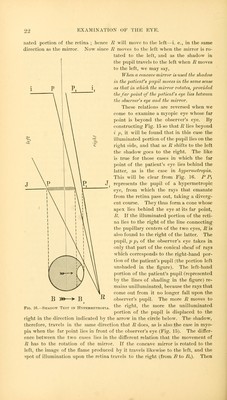
![the beam of rays returning from this spot of illumination shifts to the left, but B, since in the hypermetropic eye it lies at the prolongation of these rays back- ward, moves to the right. It, therefore, moves in a direction opposite to that in which the mirror rotates, and the same is true of the pupillary shadow, which always moves in the same way that li does. Hence when a concave mirror is used, the shadow moves in a direction opposite to that in which the mirror is rotated, provided the far point of the patient's eye lies behind the observer's eye (in low degrees of my opt a) or behind the patient's eye (in hypernietrojiin |. The way in which the shadow moves, therefore, depends upon the relative situation of the far point and the observer's eye. If the observer stations him- self at a distance of rather more than 1 m. (say 120 cm.) from the patient's eye, K lies between the two eyes when there is myopia of 1 D. or more, because then the patient's far point lies at 1 m. or less from his eye. In myopia amounting to less than 1 D. the far point lies behind the observer's eye, and the same is true of emmetropia, in which the far point lies at infinite distance. In hyper- metropia, on the other hand, the far point lies behind the patient's eye. From these facts are derived the following rules for conducting the shadow test: The observer, standing at rather more than 1 m. from the patient, illumi- nates the eye with a concave mirror, and notices the way in which the shadow moves in the patient's pupil as the mirror is rotated. If the shadow moves in the same direction that the mirror rotates, there is myojfia of 1 D. or more. Then successively stronger concave glasses are set before the patient's eye in a trial frame * until a glass is found with which the shadow travels in the reverse direction. This glass carries the far point of the eye to just beyond 1 m. (cor- responding to a refractive power of 1 D.); and the last glass, n D., with which the shadow still moves in the same sense as the mirror, corrects the myopia of the patient's eye up to approximately 1 D. Hence the total myopia of this eye is «D + l D. If, when the mirror is rotated, a movement of the shadow takes place in the opposite direction, there is then in the eye that is being examined either myopia less than 1 D., or emmetropia or hypermetropia. In this case a series of con- vex glasses is placed before the patient's eye until the shadow begins to move in the same direction as the mirror. If this glass is n D., the refraction of the patient's eye is n D — 1 D. The shadow test can also be conducted with the plane mirror. With this the image of the flame lies behind the mirror, and hence, when the latter is rotated, moves, not with the mirror, as is the case when this is concave, but in the opposite direction. Accordingly, the movement of the pupillary shadow with relation to the rotation of the mirror is just the reverse of that which obtains with the concave mirror.f * [Instead of placing a number of glasses one after another in a trial frame, we may also employ a revolving disk, a set of lorgnette frames, or an oblong slide in which a series of such glasses is permanently fixed after the fashion of an ophthal- moscope. Such an appliance, which is called a skiascope, allows the glasses before the patient's eye to be rapidly shifted either by the patient himself or by the physi- cian, without the latter having to move from his station.—D.] f [I.e., the shadow moves in the opposite direction to that in which the mirror is rotated—moves to the right when the mirror is rotated to the left, or, as the phrase is, moves against the mirror in myopia of such a degree that the](https://iiif.wellcomecollection.org/image/b21023906_0045.jp2/full/800%2C/0/default.jpg)



 No text description is available for this image
 No text description is available for this image
 No text description is available for this image