Contributions to the study of the heart and lungs / by James R. Leaming.
- James Rosebrugh Leaming
- Date:
- 1887
Licence: Public Domain Mark
Credit: Contributions to the study of the heart and lungs / by James R. Leaming. Source: Wellcome Collection.
Provider: This material has been provided by the Francis A. Countway Library of Medicine, through the Medical Heritage Library. The original may be consulted at the Francis A. Countway Library of Medicine, Harvard Medical School.
247/308 page 245
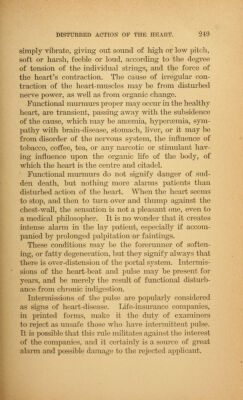
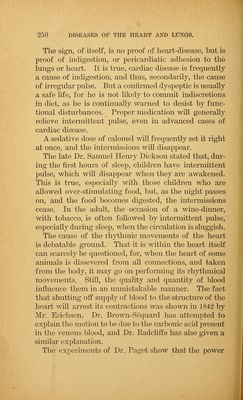
![A tabular arrangement like the following, in classify- ing murmurs acoustically, may be useful: Valvular j f or*!c obstructive systolic, (all organic.) ) ^°rtl° regurgitant diastolic. v ° ' ( Mitral regurgitant systolic. Intra-ventricular j Organic functional, (more or less functional]. \ Inorganic functional. These two great divisions are made in accordance with their acoustic differences. The sound in valvular murmurs, is a friction-murmur, that of blood forced through an aperture. The intra-ventricular murmurs are mostly and distinctly chord-vibrations. The con- traction of the muscular walls of the heart and its fleshy columns, the friction of rushing blood among the chordae tendinse and against the tense mitral valve being the occasion of sound vibrations, but is not the mechanism of the sound itself. As great difference exists between these murmurs as between that of a whisper and that of the voice. The obstructive systolic aortic may be modified by irregular calcifications in the aortic valves, extending into the column of forced rush- ing blood. In this way a harsher character may be given to the murmur, or it may even become musical. Vegetations also attached to the orifice or valve may be thrown into vibrations in the column of blood, and produce a musical murmur, but these are rare, mere possibilities. When musical murmurs occur they are almost always, vibrations of the chordae tendinse, some of which are under extraordinary tension. These sounds and murmurs may be illustrated by a stringed musical instrument. Every degree in quality of murmur or sound, from the softest blowing up to the harshest, sawing, rasping, filing, or, when the vibra- tions become sufficiently rapid and regular, into musi- cal sounds. The use of the term bellows sound by](https://iiif.wellcomecollection.org/image/b21063680_0247.jp2/full/800%2C/0/default.jpg)