Licence: Public Domain Mark
Credit: A Chinese-English dictionary / by Herbert Allen Giles. Source: Wellcome Collection.
12/1822
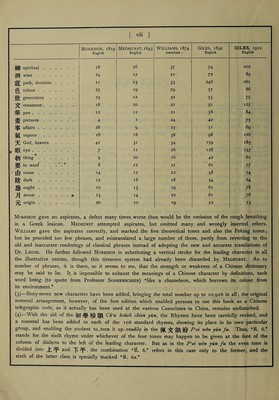
![[viii ] Morrison, 1819 English Medhurst, 1843 English Williams, 1874 American Giles, 1892 English GILES, 1912 English 神 spiritual. l8 26 37 74 102 酒 wine. H 12 21 72 89 道 path, doctrine .... 11 13 33 246 261 色 colour. 25 19 29 57 86 世 generation. 23 12 32 55 75 文ornament.. 18 20 22 91 125 筆 pen ........ 12 12 21 58 84 畫 pictures ••••.. 4 .I 24 42 75 事 affairs. 28 9 23 51 69 氣 vapour. 16 18 38 98 126 天 God, heaven .... 41 31 34 159 g 眼 eye. 7 11 26 128 157 物 thing *. 9 20 16 42 6l 要 to want . . . . ’ • • 8 /i 2 21 6l 77 9由 cause . H 12 22 58 74 陰 dark. 12 18 18 54 64 應0ught . 10 13 19 61 78 月 moon.e. 13 14 22 61 76 元origin ...... •. 20 10 19 52 73 Morrison gave no aspirates, a defect many times, worse than would be the omission of the rough breathing in a Greek lexicon. Medhurst attempted aspirates, but omitted many and wrongly inserted others. Williams gave the aspirates correctly, and marked the five theoretical tones and also the Peking tones ; but he provided too few phrases, and mistranslated a large number of those, partly from reverting to the old and inaccurate renderings of classical phrases instead of adopting the new and accurate translations of Dr. Legge. He further followed Morrison in substituting a vertical stroke for the leading character in all the illustrative entries, though this tiresome system had already been discarded by Medhurst. As to number of phrases, it is there, so it seems to me, thiat the strength or weakness of a Chinese dictionary may be said to lie. It is impossible to exhaust the meanings of a Chinese character by definitions, each word being (to quote from Professor Sonnenschein) “like a chameleon, which borrows its colour from its environment.” (3)一Sixty-seven new characters have been added, bringing the total number up to 10,926 in all; the original numeral arrangement, however,of the first edition which enabled persons to use this book as a Chinese telegraphic code, as it actually has been used at the various Consulates in China, remains undisturbed. ⑷一With the aid of the 初學檢韻 Ch{u hsuek chien yun, the Rhymes have been carefully revised, and a numeral has been added to each of the 106 standard rhymes, showing its place in its own particular gfoup,and enabling the student to一turn it up-readily in the 佩文韻府 wen yiln fu. Thus, “R. 6•” stands for. the sixth rhyme under whichever of the four tones may happen to be given at the foot of the column of dialects to the left of the leading character. But as in the P、ei wen yiin fu the even tone is divided into上平 and 下平、the combination “ll. 6•” refers in this case only to the former,and the sixth of the latter class is specially marked “R. 6a.”](https://iiif.wellcomecollection.org/image/b31352583_0012.jp2/full/800%2C/0/default.jpg)

 No text description is available for this image
 No text description is available for this image
 No text description is available for this image