Licence: Public Domain Mark
Credit: A Chinese-English dictionary / by Herbert Allen Giles. Source: Wellcome Collection.
129/1822 page 23
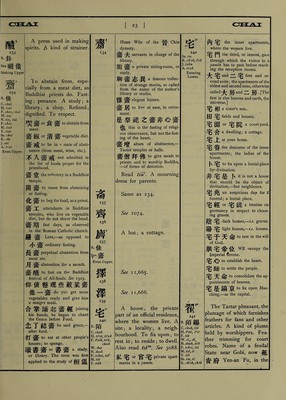
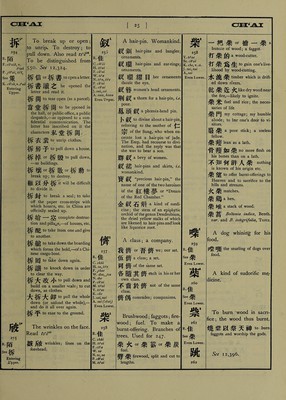
![GUJSJL C?KAT 醺1 233 R.卦 曬債 Sinking Upper W 234 R.隹 C.chdi H. tsai F. ckac、chai W. tsa N. tse, tsa P. chai M. tsai Y. tsae Sz. chai K. che J. sai A.trai Even Upper. A press used in making spirits. A kind of strainer. To abstain from, espe¬ cially from a meat diet, as Buddhist priests do. Fast¬ ing ;penance. A study; a library ; a shop. Refined ; dignified. To respect. ^ or ^ to abstain from meat. 齋飯。r 淸齋 vegetable diet. 齋戒 to be in p state of absti¬ nence (from meat, wine, etc.). 不入齋戒 not admitted in the list of foods proper for the priesthood. the refectory in a Buddhist temple. 開齋 to cease from abstaining or fasting. 化齋 to beg for food, as a priest. 齋工 attendants in Buddhist temples, who live on vegetable diet, but do not shave the head, 齋期 fast days, as observed in the Roman Catholic church 嚴齋 Lent,—as opposed to ordinary fasting. 長 perpetual abstention from meat etc. 月 abstention for a month. to fast on the Buddhist festival of All-Souls. See【325. 你便整理些蔌菜齋 ^ ―• do yor get some vegetables ready and give him a maigre meal. 合掌誦起齋經 joining his hands, he began to chant the Grace before Food. 念了結齋 he said grace,— after food. 打齋 to eat at other people’s houses; to sponge. 讀書齋。1: _齋 a study, or library. The term was first applied to the study of 桓温 齋1 134 235 236. 臨1 m 237 民隹 妒齋 Even Upper. 擇 238 m 239 宅 240 R.陌 C. chak H. ts、tt、ts^ak F. tUik、telk、 cheik W. dza N. dzah P. Schai^ ts? M. tse Y. tseh Huan Wen of the Chin dynasty. 夫 servants in charge of-the library. 閒齋 a private sitting-room, or study. 聊齋志異 a famous •collec¬ tion of strange stories, so called from the name of the author’s library or studio. 牙隹 elegant leisure. 齋居 to live at ease, in retire¬ ment. 是祭祀之齋非心齋 也 this is the fasting of religi¬ ous observance, bat not the fast¬ ing of the heart. 齋壇 altars of abstinence,- Taoist, temples or halls. 齋僧拜佛 to give meals to priests and to worship Buddha, —of forms of devotion. Read tzu1. A mourning dress for parents. Same as 234. See 1074. A hut; a cottage. See 11,665. See 11,666. A house ; the private part of an official residence, where the women live. A site ; a locality ; a neigh¬ bourhood. To fix upon ; to rest in ; to reside ; to dwell. Also read tse~^. See 3088. 私宅。r官宅 private apart¬ ments in a yamen. 240 Sz. tse K. ch、ek、^ek J. taku A. trak Entering Lower. w 241 K•陌錫 C. chak^ tik H. tHt F. tik W. di0 N. dzah、dih P. ichai'iti M. tse^ ti Y. tik Sz. tse^ ti K. ch、ek、chok 內宅 the inner apartments, where the women live. 宅門 the third, or inmost, gate through . which the visitor to s yamen has to pass before reach ing the reception rooms. 大and first and se¬ cond suite; the apartments of the eldest and second sons, otherwise called 大房 and 二房.[The first is also heaven and earth, the universe.] 宅相 a sister’s son., 田宅 fields and houses. 宅箇。r宅院 a court-yard 宅舍 a dwelling; a cottage. Jt at your home. 宅眷 the denizens of the inner apartments; the ladies of the house. 卜to fix upon a burial-place by、divination. 非宅是 K it is not a house that should be the object of divination,—but neighbours. 宅兆 an auspicious day for a funeral; a burial place. 宅經。r宅鏡 a treatise on geomancy in respect to choos¬ ing graves. 陰宅 dark homes,一ix. graves. 陽宅 light homes,—i.e. houses. 宅于天命 to rest in the will of God. 朕宅帝位 WE occupy the Imperial fhrone. O to establish the heart. 宅師 to settle the people. 宅天命 to consolidate the ap¬ pointments of heaven. 宅是鎬京 to fix upon Hao- ching,—as the capital. The Tartar pheasant, the plumage of which furnishes feathers for fans and other articles. A kind of plume held by worshippers. Fea¬ ther trimming for court robes. Name of a feudal State near Gobi, now 延 安府 Yen-an Fu, in the](https://iiif.wellcomecollection.org/image/b31352583_0129.jp2/full/800%2C/0/default.jpg)
 No text description is available for this image
 No text description is available for this image
 No text description is available for this image