Licence: Public Domain Mark
Credit: A Chinese-English dictionary / by Herbert Allen Giles. Source: Wellcome Collection.
18/1822
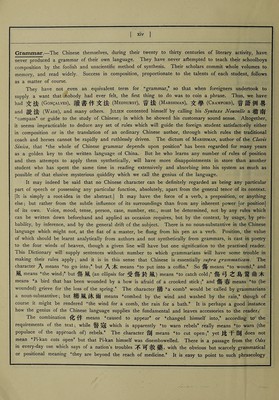
![Grammar.一The Chinese themselves, during their twenty to thirty centuries of literary activity, have never produced a grammar of their own language. They have never attempted to teach their schoolboys composition by the foolish and unscientific method of synthesis. Their scholars commit whole volumes to memory, and read widely. Success in composition, proportionate to the talents of each student, follows as a matter of course. They have not even an equivalent term for “grammar,” so that when foreigners undertook to supply a want that nobody had ever felt, the first thing to do was to coin a phrase. Thus, we have had 文法 (Gonqalves), 讀書作文法(Medhurst),言备(Marshman),文學(Crawford),言語例暑 and 說法(Wade), and many others. Julien contented himself by calling his Syntaxe Nouvelle a 指南 “compass” or guide to the study of Chinese; in which he showed his customary sound sense. Altogether, it seems impracticable to deduce any set of rules which will guide the foreign student satisfactorily either in composition or in the translation of an ordinary Chinese author, through which rules the traditional coach and horses cannot be rapidly and ruthlessly driven. The dictum of Marshman,author of the Clavis Sinica, that “the whole of Chinese grammar depends upon position” has been regarded for many years as a golden key to the written language of China. But he who learns any number of rules of position and then attempts to apply them synthetically, will have more disappointments in store than another student who has spent the same time in reading extensively and absorbing into his system as much as possible of that elusive mysterious quiddity which we call the genius of the language. It may indeed be said that no Chinese character can be definitely regarded as being any particular part of speech or possessing any particular function,absolutely, apart from the general tenor of its context. [It is simply a root-idea in the abstract.] It may have the force of a verb, a preposition, or anything else ; but rather from the subtle influence of its surroundings than from any inherent power [or position] of its own. Voice, mood,tense, person, case, number, etc., must be determined, not by any rules which can be written down beforehand and applied as occasion requires, but by the context, by usage, by pro¬ bability, by inference, and by the general drift of the subject. There is no noun-substantive in the Chinese language which might not, at the fiat of a master, be flung from his pen as a verb. Position, the value of which should be learnt analytically from authors and not synthetically from grammars, is cast in poetry to the four winds of heaven, though a given line will have but one signification to the practised reader. This Dictionary will supply sentences without number to which grammarians will have some trouble in making their rules apply ; and it is in this sense that Chinese is essentially supra gram77taticam. The character 入 means “to go into;” but 入木 means “to put into a coffin•” So傷 means ato wound,” and 風 means “the windbut 傷風(an ellipsis for 受傷於風)means ato catch cold\ 傷弓之鳥驚曲木 means “a bird that has been wounded by a bow is afraid of a crooked stick \ and 傷春 means “to (be wounded) grieve for the loss of the spring.” The character 梅 “a comb” would be called by grammarians a noun-substantive ; but 櫛風沐雨 means “combed by the wind and washed by the rain’” though of course it might be rendered “the wind for a comb, the rain for a bath•” It is perhaps a good instartce how the genius of the Chinese language supplies the fundamental and leaves accessories to the reader/ The combination 化作 means “caused to appear” or “changed himself into,” according t0y the requirements of the text ; while 警寇 which is apparently “to warn rebels” really means “to warn (the populace of the approach of) rebels•” The character 剖 means uto cut open;” yet 此千剖 does not mean u Pi-kan cuts open” but that Pi-kan himself was disembowelled. There is a passage from the Odes in every-day use which says of a nation’s troubles 不可5^ with the obvious but scarcely grammatical or positional meaning “they are beyond the reach of medicine.” It is easy to point to such phraseology](https://iiif.wellcomecollection.org/image/b31352583_0018.jp2/full/800%2C/0/default.jpg)


 No text description is available for this image
 No text description is available for this image
 No text description is available for this image