Licence: Public Domain Mark
Credit: A Chinese-English dictionary / by Herbert Allen Giles. Source: Wellcome Collection.
236/1822 page 130
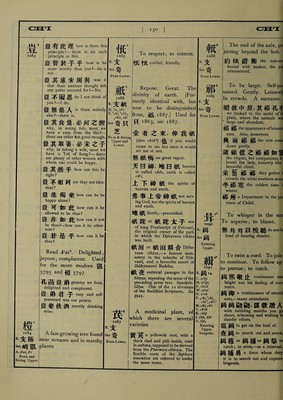
![豈3 io8_j See 豈有此迤 how is there thisl principle ? — there is no such principle as this. 豈賢於子乎 how is he I more worthy than you?—he is not. was it 豈其慮未周與 that their anxious thought left any point uncared for?—No. 豈不爾思 do I not think of| you?—I do. 豈無他人 is there nobody else?—there is. 豈其食魚,必河之鯉 why, in eating fish, must we have a carp from the Ho ? there are other fish good enough. 豈其取妻,必朱之子 why, in taking a wife, must we have a Tzu of Sung?^there are plenty of other women with whom one could be happy 豈其然乎 how can this be right ? 豈不相同 are they not iden¬ tical? 豈能獨樂 how can he be happy alone? 豈可如此how can it be allowed to be thus? 豈非如此 how can it not be thus?一how can it be other¬ wise? 豈若是乎hcnv can it be thus? Even Lower. 祇2 To respect ; to esteem. 恍个氏 cordial; friendly. 軾3 i.o88 IR.支 I See 奇 Even Lower. 1086 支紙 H. c, ikH F.〔chie、 Cchie、iki See奇只 芝 Repose. Great. Thel divinity of earth. [For-I 1089 merly identical with, but|R.支 now to be distinguished |see 奇 Even Lower. Even & Rising Upper and Lower. from,祗 1887.] Used for| 只 1863,⑽ 1887. 壹者之來,俥我祇 (also chi/12) 也 if you would I come to me but once it would! set me at rest. Read k、ai\ Delighted ; joyous; complacent. Used for the more modern 凱 5795 and 禮5797. 孔_豈弟 grandly we feast, delighted and complacent. 豈弟君子 easy and self- possessed was our prince. 豈樂飫酒 merrily drinking wine. fe 1084 支賄 崎凱 A. kH Even and Rising Upper. A fast-growing- tree found near streams and in marshy places. 無祇悔 no great regret. 天曰神,地曰祇 heavenI is called sken} earth is called! ch‘i, 上下神祇心 spirits of| heaven and earth. 弗事上帝神祇not serv-l ing God, nor the spirits of heaven | and earth. 地祇 Earth, 一person ified. 祇陀。r祇跎太子1 of king Prasenadjit of S’rivasti, 芪S 1087 R.支 See奇 Even Lower. 葺 1090 the original owner of the parkj |R.緝 in which the Djetavana vihara|see was built. I 祇洹。r辦洹精舍Djeta-| ^ vana vihara,一a famous mon astery in the suburbs of S'ra-I ^ vast!, and a favourite resort ofl agH Shakyamuni Buddha. I xop? 祇夜 metrical passages in the Sutras, repeating the sense of the IC, ts^ep preceding prose text. Sanskrit: IH. tsHp^ Geya. One of the 12 divisions | F。 of the Buddhist Scriptures. See\W淤ai r IN. tsHh 3945 • h.cai,cchi, chi\ chH M. chi、ch^i A medicinal plant, oflK.^ which there are several 1^; sh^2djTi varieties 黃莴 a yellowish root, with thick rind and pith inside, used I in asthma, supposed to be derived I from the Ptar mica sibirica. The! flexible roots of the Sophora I tomentosa are referred to under | the same name. Entering Upper. Irregular. The end of the axle, pr jecting beyond the hub. 約概錯衡the axie eni leather, the yol bound with ornamented. To be large. Self-poi sessed. Gently. Leisurel] In crowds. A surname. 贈彼中原,其祁孔窄 we looked to the midst of tl: plain, where the animals wei v large and abundant. 祁祁 the appearance of leisurel ease. Also, numerous. 典雨祁祁the rain comf down gently. 諸娣從之祁祁如雲 the virgins, her companions, fo lowed the lady, leisurely like beautiful cloud. 采蘩祁祁 they gather i: crowds the white sou them-wooc 冬祁寒 the coldest time ii winter. 祁州 a Department in the prc vince of Chihli. To whisper in the ear To asperse ; to blame. 無冓茸以悦聽d。noth fond of hearing slander. To twist a cord. To join to continue. To follow up to pursue; to catch. 緝熙敬止 continuous anc bright was his feeling of reve rence. 辑御 a continuance of attend¬ ants,一many attendants: 緝緝翩翩,謀欲譖人 with babbling mouths you go about, scheming and wishing to slander others. 巡 to get on the trail of. 查辑 to search out .and arrest. 緝獲。r _捕。r辑_ t() catch; to seize,—as a criminal. 緝捕勇 a force whose duty it is to search out aud capture brigands.](https://iiif.wellcomecollection.org/image/b31352583_0236.jp2/full/800%2C/0/default.jpg)
 No text description is available for this image
 No text description is available for this image
 No text description is available for this image