A treatise on the physiological and moral management of infancy : being a practical exposition of the principles of infant training, for the use of parents / by Andrew Combe.
- Date:
- 1854
Licence: Public Domain Mark
Credit: A treatise on the physiological and moral management of infancy : being a practical exposition of the principles of infant training, for the use of parents / by Andrew Combe. Source: Wellcome Collection.
Provider: This material has been provided by the Royal College of Physicians of Edinburgh. The original may be consulted at the Royal College of Physicians of Edinburgh.
177/188 page 161
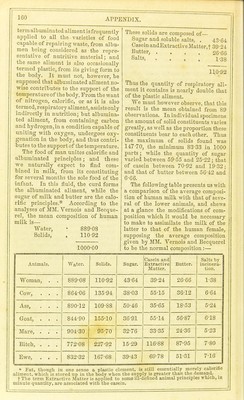
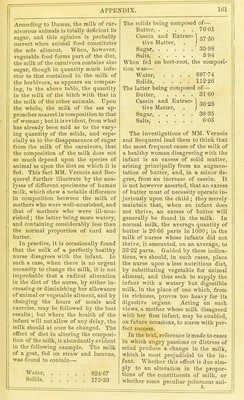
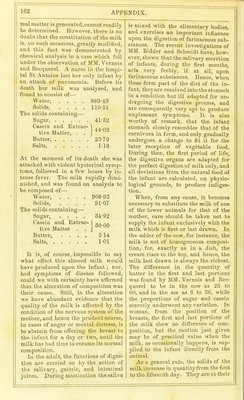
![According to Dumas, the milk of car- nivorous animals is totally deficient in sugar, and this opinion is probably correct when animal food constitutes the sole aliment. When, however, vegetable food forms part of the diet, the milk of the carnivora contains also sugar, though in quantity much infe- rior to that contained in the milk of the herbivora, as appears on compar- ing, in the above table, the quantity in the milk of the hitch with that in the milk of the other animals. Upon the whole, the milk of the ass ap- proaches nearest in composition to that of woman; but it is evident, from w’hat has already been said as to the vary- ing quantity of the solids, and espe- cially as to the disappearance of sugar from the milk of the carnivora, that the composition of the milk does not so much depend upon the species of animal as upon the diet on which it is fed. This fact MM. Vernois and Bec- querel further illustrate by the ana- lyses of different specimens of human milk, which shew a notable difference in composition between the milk of mothers who were well-nourished, and that of mothers who were ill-nou- rished ; the latter being more watery, and containing considerably less than the normal proportion of curd and butter. In practice, it is occasionally found that the milk of a perfectly healthy nurse disagrees with the infant. In such a case, when there is no urgent necessity to change the milk, it is not improbable that a radical alteration in the diet of the nurse, by either in- creasing or diminishing her allowance of animal or vegetable aliment, and by changing the hours of meals and exercise, may be followed by the best results; but where the health of the infant will not allow of any delay, the milk should at once be changed. The effect of diet in altering the composi- tion of the milk, is abundantly evident in the following example. The milk of a goat, fed on straw and lucerne, was found to contain— Water, 824-67 Solids, 175-33 The solids being composed of— Butter, 76-01 Casein and Extrac- ] ew,..A tive Matter, . j 57 °° Sugar, 35-98 Salts, 5-84 When fed on beet-root, the composi- tion was— Water, .... 887-74 Solids, .... 112-26 The latter being composed of— Butter, .... 31-60 Casein and Extrac- 1 gg^Q tive Matter, . J Sugar, 38-35 Salts, 6-05 The investigations of MM. Vernois and Becquerel lead them to think that the most frequent cause of the milk of a healthy woman disagreeing with the infant is an excess of solid matter, arising principally from an augmen- tation of butter, and, in a minor de- gree, from an increase of casein. It is not however asserted, that an excess of butter must of necessity operate in- juriously upon the child; they merely maintain that, when an infant does not thrive, an excess of butter will generally be found in the milk. In normal milk, the average quantity of butter is 26-66 parts in 1000; in the milk of nurses whose infants did not thrive, it amounted, on an average, to 33-22 parts. Guided by these indica- tions, we should, in such cases, place the nurse upon a less nutritious diet, by substituting vegetable for animal aliment, and thus seek to supply the infant with a watery but digestible milk, in the place of one which, from its richness, proves too heavy for its digestive organs. Acting on such views, a mother whose milk disagreed with her first infant, may be enabled, on future occasions, to nurse with per- fect success. In the text, reference is made to cases in which angry passions or distress of mind produce a change in the milk, which is most prejudicial to the in- fant. Whether this effect is due sim- ply to an alteration in the propor- tions of the constituents of milk, or whether some peculiar poisonous ani-](https://iiif.wellcomecollection.org/image/b21987907_0177.jp2/full/800%2C/0/default.jpg)