Licence: Public Domain Mark
Credit: Vaccine and vaccination / by George Dock. Source: Wellcome Collection.
Provider: This material has been provided by the Harvey Cushing/John Hay Whitney Medical Library at Yale University, through the Medical Heritage Library. The original may be consulted at the Harvey Cushing/John Hay Whitney Medical Library at Yale University.
3/20 page 1
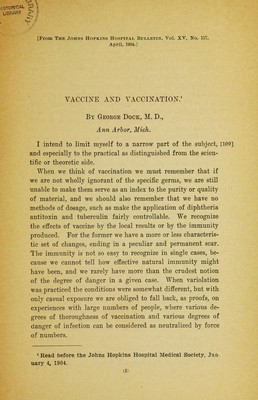
![[From The Johns Hopkins Hospital Bulletin, Vol. XV, No. 157 April, 1904.] VACCINE AND VACCINATION.1 By George Dock, M. D., Ann Arbor, Mich. I intend to limit myself to a narrow part of the subject, [109] and especially to the practical as distinguished from the scien- tific or theoretic side. When we think of vaccination we must remember that if we are not wholly ignorant of the specific germs, we are still unable to make them serve as an index to the purity or quality of material, and we should also remember that we have no methods of dosage, such as make the application of diphtheria antitoxin and tuberculin fairly controllable. We recognize the effects of vaccine by the local results or by the immunity produced. For the former we have a more or less characteris- tic set of changes, ending in a peculiar and permanent scar. The immunity is not so easy to recognize in single cases, be- cause we cannot tell how effective natural immunity might have been, and we rarely have more than the crudest notion of the degree of danger in a given case. When variolation was practiced the conditions were somewhat different, but with only casual exposure we are obliged to fall back, as proofs, on experiences with large numbers of people, where various de- grees of thoroughness of vaccination and various degrees of danger of infection can be considered as neutralized by force of numbers. 1 Read before the Johns Hopkins Hospital Medical Society, Jan- uary 4. 1904. (1)](https://iiif.wellcomecollection.org/image/b21027031_0003.jp2/full/800%2C/0/default.jpg)