Licence: Public Domain Mark
Credit: Vaccine and vaccination / by George Dock. Source: Wellcome Collection.
Provider: This material has been provided by the Harvey Cushing/John Hay Whitney Medical Library at Yale University, through the Medical Heritage Library. The original may be consulted at the Harvey Cushing/John Hay Whitney Medical Library at Yale University.
4/20 page 2
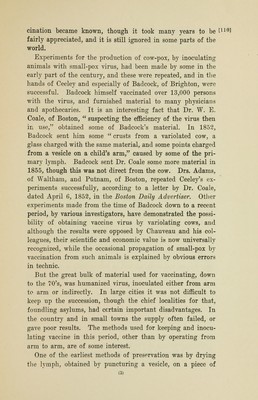
![f10f|l The Material Used. In the earliest days of vaccination the so-called lymph from vesicles on human beings was used. In Jenner's memorable experiment on James Phipps he used the virus from a cow- pox vesicle on the hand of a dairy-maid, but later he inocu- lated from a vesicle on the nipple of a cow. After a few transfers this stock died out, as the former had done, but soon after the publication of Jenner's first work several new strains were obtained. Many of these were kept on by inocu- lating from arm to arm, or indirectly, and so were spread all over the world. It is interesting to remember that in Amer- ica the virus was introduced by Waterhouse in Boston and Hosack in New York, the Southern States being early sup- plied by Waterhouse through the interest of President Jeffer- son. Some of the early vaccine was kept up for a long time. Drake tells us that he could see no change in course or phe- nomena in that used in the West in the forty-four years fol- lowing its introduction in 1802. According to Kaposi, the 1110] material in the Vienna Vaccine Institute was descended from some sent by Jenner to De Carro in 1802, and retained its efficiency in the late 80's. But it did not always keep so well. L. Pfeiffer mentions some that he saw a few years ago, of the same origin, so degenerated that it gave only a minimal areola and the scab dropped off on the 13th day. Even in the first few years after Jenner's announcement the degeneration of virus was often observed, and the search for new cow-pox virus was made. It became more lively in the 20's, stimulated by the revival of small-pox in many coun- tries, often affecting vaccinated persons. Partly from the incomplete protection thus shown, partly from the imperfect development of the vaccine lesions, it was believed that the material in use was not as potent as it had been in the be- ginning. But as a result of the lessened prevalence of small- pox, natural cow-pox was much less frequent than in Jen- ner's time. Eewards were offered in some countries for the discovery of cow-pox. Eetro-vaccination, or the inoculation of the cow with human virus, was used for the purpose of re- viving the stock. About the same time, that is in the end of the first third of the nineteenth century, the value of revac- «)](https://iiif.wellcomecollection.org/image/b21027031_0004.jp2/full/800%2C/0/default.jpg)