Licence: Public Domain Mark
Credit: Vaccine and vaccination / by George Dock. Source: Wellcome Collection.
Provider: This material has been provided by the Harvey Cushing/John Hay Whitney Medical Library at Yale University, through the Medical Heritage Library. The original may be consulted at the Harvey Cushing/John Hay Whitney Medical Library at Yale University.
5/20 page 3
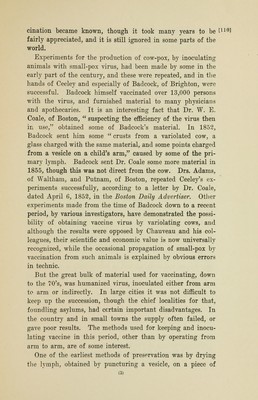
![cination became known, though it took many years to be tu°] fairly appreciated, and it is still ignored in some parts of the world. Experiments for the production of cow-pox, by inoculating animals with small-pox virus, had been made by some in the early part of the century, and these were repeated, and in the hands of Ceeley and especially of Badcock, of Brighton, were successful. Badcock himself vaccinated over 13,000 persons with the virus, and furnished material to many physicians and apothecaries. It is an interesting fact that Dr. W. E. Coale, of Boston, suspecting the efficiency of the virus then in use, obtained some of Badcock's material. In 1852, Badcock sent him some crusts from a variolated cow, a glass charged with the same material, and some points charged from a vesicle on a child's arm, caused by some of the pri- mary lymph. Badcock sent Dr. Coale some more material in 1855, though this was not direct from the cow. Drs. Adams, of Waltham, and Putnam, of Boston, repeated Ceeley's ex- periments successfully, according to a letter by Dr. Coale, dated April 6, 1852, in the Boston Daily Advertiser. Other experiments made from the time of Badcock down to a recent period, by various investigators, have demonstrated the possi- bility of obtaining vaccine virus by variolating cows, and although the results were opposed by Chauveau and his col- leagues, their scientific and economic value is now universally recognized, while the occasional propagation of small-pox by vaccination from such animals is explained by obvious errors in technic. But the great bulk of material used for vaccinating, down to the 70's, was humanized virus, inoculated either from arm to arm or indirectly. In large cities it was not difficult to keep up the succession, though the chief localities for that, foundling asylums, had certain important disadvantages. In the country and in small towns the supply often failed, or gave poor results. The methods used for keeping and inocu- lating vaccine in this period, other than by operating from arm to arm, are of some interest. One of the earliest methods of preservation was by drying the lymph, obtained by puncturing a vesicle, on a piece of](https://iiif.wellcomecollection.org/image/b21027031_0005.jp2/full/800%2C/0/default.jpg)