A series of cases to illustrate ovariotomy in a general surgical clinic / by Mayo Robson.
- Robson, Arthur William Mayo, Sir, 1853-1933.
- Date:
- 1895
Licence: Public Domain Mark
Credit: A series of cases to illustrate ovariotomy in a general surgical clinic / by Mayo Robson. Source: Wellcome Collection.
Provider: This material has been provided by The Royal College of Surgeons of England. The original may be consulted at The Royal College of Surgeons of England.
1/12
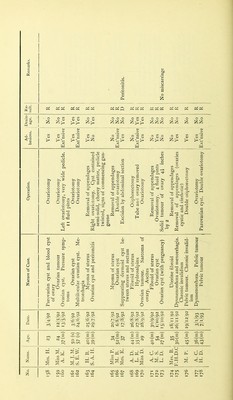
![{Reprinted from The Quarterly Medjcal Journal, July, 1895.] A SERIES OF CASES X0-4LLUSTI9^TE OVARIOTOMY IN A GENERA't-SJ^RCrfCAL CLINIC. BY MAYO ROBSON, F.R.CS. Senior Surgeon Leeds General Infirmary ; Professor of Surgery in the Victoria University ; Member of Council of the Royal College of Surgeons, England. The following is a consecutive series of cases of ovariotomy- performed in a general surgical clinic. The cases are in no sense of the word selected, as whenever operation has offered any chance of success it has been performed, statistics not being considered. My excuse, if such be required for publishing the list, is the desire to demonstrate the fact, that with due care, ovariotomy can be safely and efficiently performed in the ordinary surgical wards of a general hospital and that seclusion and isolation are by no means necessary to success. The cases number 219, the mortality being at the rate of 5-02 per cent., or if the malignant cases be included 5'93 per cent. In looking through the list it is seen that the thirteen recorded fatal cases may with advantage be submitted to analysis, the prevent- able being distinguished from the probably unavoidable deaths. Two patients (Nos. 151 and 194) died from malignant disease, one ten days after operation, the other from shock within a few hours. Two succumbed to intestinal obstruction, one on the eighth day from volvulus of the small intestine, the other from gangrene of about a foot of bowel owing to injury to the mesentery in separating adhesions. One case (No. 90) was admitted with acute peritonitis and was operated on to give her a last chance; in this case death was certainly not due to operation, although it followed it. In Case 153, operated on for faecal fistula of four years’ duration following on pelvic suppuration and accompanied by a pelvic](https://iiif.wellcomecollection.org/image/b22331165_0003.jp2/full/800%2C/0/default.jpg)