On binocular flicker and the correlation of activity of 'corresponding' retinal points / by C. S. Sherrington.
- Charles Scott Sherrington
- Date:
- [1904]
Licence: In copyright
Credit: On binocular flicker and the correlation of activity of 'corresponding' retinal points / by C. S. Sherrington. Source: Wellcome Collection.
Provider: This material has been provided by UCL Library Services. The original may be consulted at UCL (University College London)
28/39 page 49
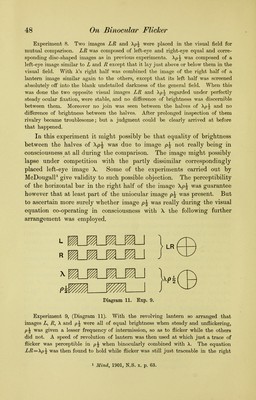
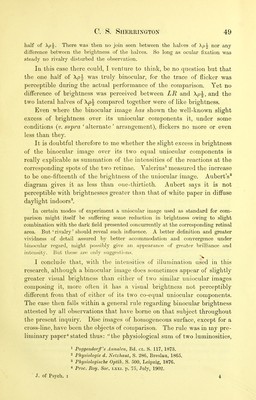
![half of Xpj. Tliere was then no join seen hetween the halves of Xp^ nor any difference between the brightness of the halves. So long as ocular fixation was steady no rivalry disturbed the observation. In this case there could, I venture to think, be no question but that the one half of \ph was truly binocular, for the trace of flicker was perceptible during the actual performance of the comparison. Yet no difference of brightness was perceived between LR and Xp^, and the two Literal halves of compared together were of like brightness. Even where the binocular image has shown the well-known slight excess of brightness over its uniocular components it, under some conditions (v. supra 'alternate' arrangement), flickers no more or even less than they. It is doubtful therefore to me whether the slight excess in brightness of the binocular image over its two equal uniocular components is really explicable as summation of the intensities of the reactions at the corresponding spots of the two retinae. Valerius^ measured the increase to be one-fifteenth of the brightness of the uniocular image. Aubert's^ diagram gives it as less than one-thirtieth. Aubert says it is not perceptible with brightnesses greater than that of white paper in diffuse daylight indoors I In certain modes of experiment a uniocular image used as standard for com- parison might itself be suffering some reduction in brightness owing to slight combination with the dark field presented concurrently at the corresponding retinal area. But ' rivalry' should reveal such influence. A better definition and greater vividness of detail assured by better accommodation and convergence under binocular regard, might ]iossibly give an ap})earance of greater brilliance and intensity. But these are only siigmvstiMjis. I conclude that, with the intensities of illumination used in this research, although a binocular image does sometimes appear of slightly greater visual brightness than either of two similar uniocular images composing it, more often it has a visual brightness not perceptibly different from that of either of its two co-equal uniocular components. The case then falls within a general rule regarding binocular brightness attested by all observations that have borne on that subject throughout the present inquiry. Disc images of homogeneous surface, except for a cross-line, have been the objects of comparison. The rule was in my pre- liminary paper^ stated thus: the physiological sum of two luminosities, 1 Poggendorff's Anualen, Bd. cl. S. 117, 1873. 2 Physiologie d. Netzhaut, S. 286, Breslau, 1865. 3 Physiologische Optik, S. 500, Leipzig, 1876. 4 Proc. Roy. Soc. lxxi. p. 75, July, 1902. J. of Psych. I 4](https://iiif.wellcomecollection.org/image/b21638147_0029.jp2/full/800%2C/0/default.jpg)