Volume 1
A mathematical and philosophical dictionary: containing an explanation of the terms, and an account of the several subjects, comprized under the heads mathematics, astronomy, and philosophy both natural and experimental: with an historical account of the rise, progress, and present state of these sciences: also memoirs of the lives and writings of the most eminent authors. Both ancient and modern, who by their discoveries or improvements have contributed to the advancement of them ... With many cuts and copper-plates / By Charles Hutton.
- Charles Hutton
- Date:
- 1795-1796
Licence: Public Domain Mark
Credit: A mathematical and philosophical dictionary: containing an explanation of the terms, and an account of the several subjects, comprized under the heads mathematics, astronomy, and philosophy both natural and experimental: with an historical account of the rise, progress, and present state of these sciences: also memoirs of the lives and writings of the most eminent authors. Both ancient and modern, who by their discoveries or improvements have contributed to the advancement of them ... With many cuts and copper-plates / By Charles Hutton. Source: Wellcome Collection.
628/696 (page 600)
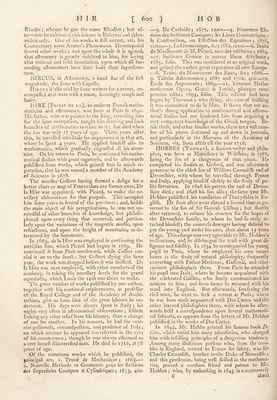
![H I .R [ 600 ] HOB ivhodes ; wlience he got the name Rhodius ; but af- terwards-he cultivated tills fcicnce in Bitliynia and Alex- andria only. One of his works is Hill extant, viz, his Commentary upon Aratiis's Phenomena. He compofed feveral other works ; and upon the whole it is agreed, that aftronomy is greatly indebted to him, for laying that rational and lolid foundation, upon which all fuc- ceeding ailronomers have fince built their fuperftruc- ture. HIRCUS, in Aftronomy, a fixed ftar of the firft magnitude, the faiue with Capella. H iRCus is alfo ufed by feme writers for a comet, en- compafled as it were with a mane, feemingly rough and hairy. PURE (Philip de la), an eminent French mathe- matician and aftronomer, vras born at Paris in 1640. His father, who was painter to the king, intending him for tlie fame occupation, taught him drawing andfuch •branches of mathematics as relate to it : but died when the fon was only 17 years of age. Three years after this, he travelled into Italy for improvement in that art, where he fpent 4 years. He applied himfelf alfo to mathematics, which gradually engrofted all his atten- :tion. On his return to Paris, he continued his mathe- matical ftudies with great eagernefs, and he afterwards publiihed fome works, which gained him fo much re- putation, that he was named a member of the Academy of Sciences in 1678. The minifter Colbert having formed a defign for a better chart or map of France than any former ones, De la Hire was appointed, with Picard, to make the ne- ceffary obfervations for that purpofe. This occupied him fome years in feveral of the provinces ; and, befide the main objedl of his peregrinations, he was not un- mindful of other branches of knowledge, but philofo- phized upon every thing that occurred, and particu- larly upon the variations of the magnetic needle, upon r-efradtions, and upon the height of mountains, as de- termined by the barometer. In 1683, dela Hire was employed in continuing the meridian line, which Picard had begun in 1669. He continued it from Paris northward, while Caffini car- ried it on to the fouth : but Colbert dying the fame year, the work was dropped before it was finifiied. De la Hire was next employed, with other members of the academy, in taking the neceffary levels for the grand aquedu&LS, which Louis the 14th was about to make. The great number of works publifhed by our author, together with his continual emiployments, as profeflbr of the Royal College and of the Academy of Archi- tedlure, give us fome idea of the great labours he un- derwent. His days were always fpent in ftudy ; his nights very often in aftronomical obiervations ; feldom feeking any other relief from his labours, than a change of one for another. In his manner, he had the exte- rior politenefs, circumfpedtion, and prudence of Italy; on which account he appeared too referved in the eyes of his countrymen ; though he was always efteemed as a very honeft difinterefted man. He died in 1718, at 78 years of age. Of the numerous works which he publiflied, the principal are, i. Traite de Mechanique ; 1665.“— 2.. Nouvelle Methode en Geometric pour les Sections des Superficies Coniques & Cylindriques; 1673, qto. —3. De Cycloide ; 1677, i2mo.-—4. Nouveaux Ele- inens des Secdiones Coniques: les Lieux Geometriques; la Conftrudlion, ou Effedtion des Equations ; 1678, i2mo.-—-5.LaGnomonique, &c; 1682.12100.—6.Traite du Nivellement de M. Picard, avec des additions ; 1684. ■—7. Se-cliones Conicie in novern libros diftributse j 1685, folio. This was confidered as an original work, and gained tiie author great reputation all over Europe, -—8. Traite du Mouvement des Eaux, &c ; 1686.— 9. Tabulas Aftronomicie ; 1687 1702, pto.—10. Ecole des Arpenteurs ; 1689.—11. Veterum Mathe- maticorum Opera, Gimce 8c Eatine, pleraque nunc primum edita; 1693, foHi* This edition had been begun by Thevenot ; who dying, tlie care of finiftiing it was committed to de la Plire. It fiiews that our an- tlior’s ftrong application to mathematical and aftrono- mical ftudies had not hindered liim from acquiring a very competent knowledge of the Greek tongue. Be- fide thefe, and other fmaller works, there are a vaft num- ber of his pieces fcattered up and down in Journals, and particularly in the Memoirs of the Academy of Sciences, viz, from 1666 till the year 1718. HOBBES (Thomas), a famous writer and philo- pher, was born at Malmfbiiry in Wiltfliire, in 1588, being the fon of a clergyman of that place. He completed his ftudies at Oxford, and was afterwards governor to the eldeft fon of William Cavendifh earl of Devonihire, with whom he travelled through France and Italy, applying himfelf clofely to the ftudy of po- lite literature. In 1626 his patron the earl of Devon- fhire died; and 1628 his fon alfo; the fame year Mr. Hobbes publiflied his tranilation of Thucydides in En- glifli. He foon after went abroad a fecond time as go- vernor to the fon of Sir Gervafe Clifton ; but fliortly after returned, to refume his concern for the hopes of the Devonihire family, to whom he had fo early at- tached himfelf; the countefs dowager having deft red to put the young earl under his care, then about 13 years -of age. This charge was very agreeable to Mr. Hobbes’s inclinations, and he difeharged the truft with great di- ligence and fidelity. In 1634 he accompanied his young pupil to Paris, where he employed his own vacant hours in the ftudy of natural philofophy, frequently converfing with Father Merfemre, GalTendi, and other eminent philofophers there. From Paris he attended his pupil into Italy, where he became acquainted with the celebrated Galileo, who freely communicated his notions to him ; and from hence he returned with his ivard into England. But afterwards, forefeeing the civil wars, he went to feek a retreat at Pans; where he was foon made acquainted with Des Cartes and the other learned philofophers there, with whom he after- wards held a correfpondence upon feveral mathemati- cal fubjedls, as appears from the letters of Mr. Hobbes publiflied in the works of Des Cartes. In 1642, Mr. Hobbs pn'nted his famous book Che, which raifed him many adverfaries, who charged him with inftilling principles of a dangerous tendency. Among many illuftrious perfons who, from the trou- bles in England, retired to France for fafety, was Sir* 'Charles Cavendifh, brother to the Duke of Newcaftle : and this gentleman, being well fleilled in the mathema- tics, proved a conftant friend and patron to Mr. Hobbes; who, by embarking in 1645 in a controverfy 6 about](https://iiif.wellcomecollection.org/image/b28771485_0001_0628.jp2/full/800%2C/0/default.jpg)