Volume 1
The history of epidemics. In seven books / [Hippocrates] ; translated into English from the Greek, with notes and observations, and a preliminary dissertation on the nature and cause of infection, by Samuel Farr.
- Epidemics
- Date:
- 1780
Licence: Public Domain Mark
Credit: The history of epidemics. In seven books / [Hippocrates] ; translated into English from the Greek, with notes and observations, and a preliminary dissertation on the nature and cause of infection, by Samuel Farr. Source: Wellcome Collection.
17/452 page 9
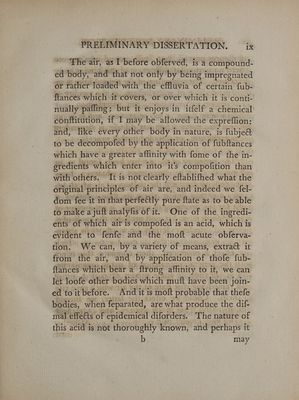
![‘The air, as I before obferved, is a compound- ed body, and that not only by being impregnated or rather loaded with the effluvia of certain fub- | ftances which it covers, or over which it is conti- nually pafling ; but it enjoys in itfelf' a chemical conftitution, eas may be allowed the expreflion: and, like every other body in nature, is fubjeét to be decompofed by the application of fubftances which have a greater affinity with fome of the in- gredients which ‘enter into it’s compofition than with others. It is not clearly eftablifhed what the original principles of air are, and indeed we {ε]- dom fee it in that perfe@ly pure ‘flate as to be able to make a juft analy fis of it. One of the ingredi- ents of which air is compofed is an acid, which is evident to fenfe and the moft acute obferva- tion. We can, by a variety of means, extract it from the air, and by application of thofe fub- {tances which bear a ftrong affinity to it, we can let loofe other bodies which muft have been j join- ed toitbefore. And it is moft probable that thefe bodies, when feparated, are what produce the dif- mal effeéts of epidemical diforders. The nature of this acid is not thoroughly known, and perhaps it b. may](https://iiif.wellcomecollection.org/image/b33518683_0001_0017.jp2/full/800%2C/0/default.jpg)