The simple carbohydrates and the glucosides / by E. Frankland Armstrong.
- Edward Frankland Armstrong
- Date:
- 1910
Licence: In copyright
Credit: The simple carbohydrates and the glucosides / by E. Frankland Armstrong. Source: Wellcome Collection.
40/132 page 24
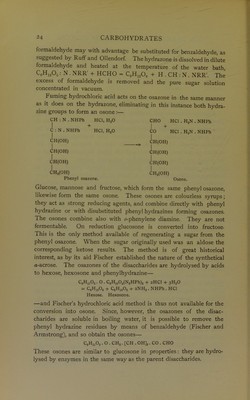
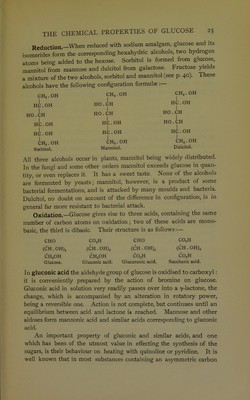
![formaldehyde may with advantage be substituted for benzaldehyde, as suggested by Ruff and Ollendorf. The hydrazone is dissolved in dilute formaldehyde and heated at the temperature of the water bath, C6H1205: N . NRR' + HCHO = C6H1206 + H . CH : N. NRR'. The excess of formaldehyde is removed and the pure sugar solution concentrated in vacuum. Fuming hydrochloric acid acts on the osazone in the same manner as it does on the hydrazone, eliminating in this instance both hydra- zine groups to form an osone:— CH : N . NHPh HCl, H20 CHO 1 + C : N . NHPh HCl, H20 1 + CO CH(OH) CH(OH) (!h(OH) CH(OH) CH(OH) | CH(OH) I CHa(OH) CHo(OH) HCl HCI HjN H2N NHPh NHPh Osone. Glucose, mannose and fructose, which form the same phenyl osazone, likewise form the same osone. These osones are colourless syrups; they act as strong reducing agents, and combine directly with phenyl hydrazine or with disubstituted phenyl hydrazines forming osazones. 7 he osones combine also with <?-phenylene diamine. They are not fermentable. On reduction glucosone is converted into fructose. This is the only method available of regenerating a sugar from the phenyl osazone. When the sugar originally used was an aldose the corresponding ketose results. The method is of great historical interest, as by its aid Fischer established the nature of the synthetical a-acrose. The osazones of the disaccharides are hydrolysed by acids to hexose, hexosone and phenylhydrazine— C6Hn05.0 . C6H10O4(NsHPh), + 2HCI + 3H20 = C6H]206 + C6H]0O6 + 2NH2 . NHPh . HCl Hexose. Hexosone. —and Fischer’s hydrochloric acid method is thus not available for the conversion into osone. Since, however, the osazones of the disac- charides are soluble in boiling water, it is possible to remove the phenyl hydrazine residues by means of benzaldehyde (Fischer and Armstrong), and so obtain the osones— C6Hn05. O . CH2. [CH . OH]3. CO . CHO These osones are similar to glucosone in properties: they are hydro- lysed by enzymes in the same way as the parent disaccharides.](https://iiif.wellcomecollection.org/image/b28062954_0040.jp2/full/800%2C/0/default.jpg)
 No text description is available for this image
 No text description is available for this image
 No text description is available for this image