The simple carbohydrates and the glucosides / by E. Frankland Armstrong.
- Edward Frankland Armstrong
- Date:
- 1910
Licence: In copyright
Credit: The simple carbohydrates and the glucosides / by E. Frankland Armstrong. Source: Wellcome Collection.
47/132 page 31
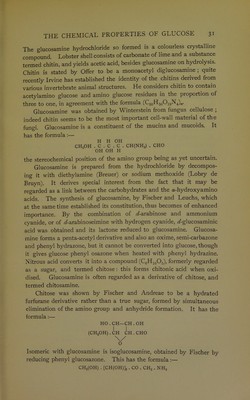
![The glucosamine hydrochloride so formed is a colourless crystalline compound. Lobster shell consists of carbonate of lime and a substance termed chitin, and yields acetic acid, besides glucosamine on hydrolysis. Chitin is stated by Offer to be a monoacetyl diglucosamine ; quite recently Irvine has established the identity of the chitins derived from various invertebrate animal structures. He considers chitin to contain acetylamino glucose and amino glucose residues in the proportion of three to one, in agreement with the formula (C30H50O19N4)„. Glucosamine was obtained by Winterstein from fungus cellulose ; indeed chitin seems to be the most important cell-wall material of the fungi. Glucosamine is a constituent of the mucins and mucoids. It has the formula :— H H OH CH„OH . C . C . C . CH(NH2) . CHO OH OH H the stereochemical position of the amino group being as yet uncertain. Glucosamine is prepared from the hydrochloride by decompos- ing it with diethylamine (Breuer) or sodium methoxide (Lobry de Bruyn). It derives special interest from the fact that it may be regarded as a link between the carbohydrates and the a-hydroxyamino acids. The synthesis of glucosamine, by Fischer and Leuchs, which at the same time established its constitution, thus becomes of enhanced importance. By the combination of ^-arabinose and ammonium cyanide, or of rf-arabinoseimine with hydrogen cyanide, <^-glucosaminic acid was obtained and its lactone reduced to glucosamine. Glucosa- mine forms a penta-acetyl derivative and also an oxime, semi-carbazone and phenyl hydrazone, but it cannot be converted into glucose, though it gives glucose phenyl osazone when heated with phenyl hydrazine. Nitrous acid converts it into a compound (C6H10O5), formerly regarded as a sugar, and termed chitose: this forms chitonic acid when oxi- dised. Glucosamine is often regarded as a derivative of chitose, and termed chitosamine. Chitose was shown by Fischer and Andreae to be a hydrated furfurane derivative rather than a true sugar, formed by simultaneous elimination of the amino group and anhydride formation. It has the formula:— HO.CH—CH.OH I I (CH2OH) . CH CH . CHO \/ o Isomeric with glucosamine is isoglucosamine, obtained by Fischer by reducing phenyl glucosazone. This has the formula:— CH2(OH) . [CH(OH)],. CO . CH2. NHS](https://iiif.wellcomecollection.org/image/b28062954_0047.jp2/full/800%2C/0/default.jpg)
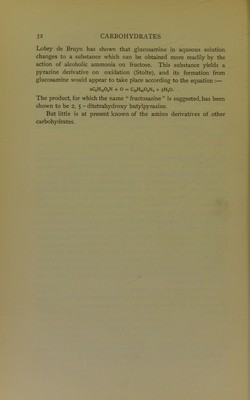
 No text description is available for this image
 No text description is available for this image
 No text description is available for this image