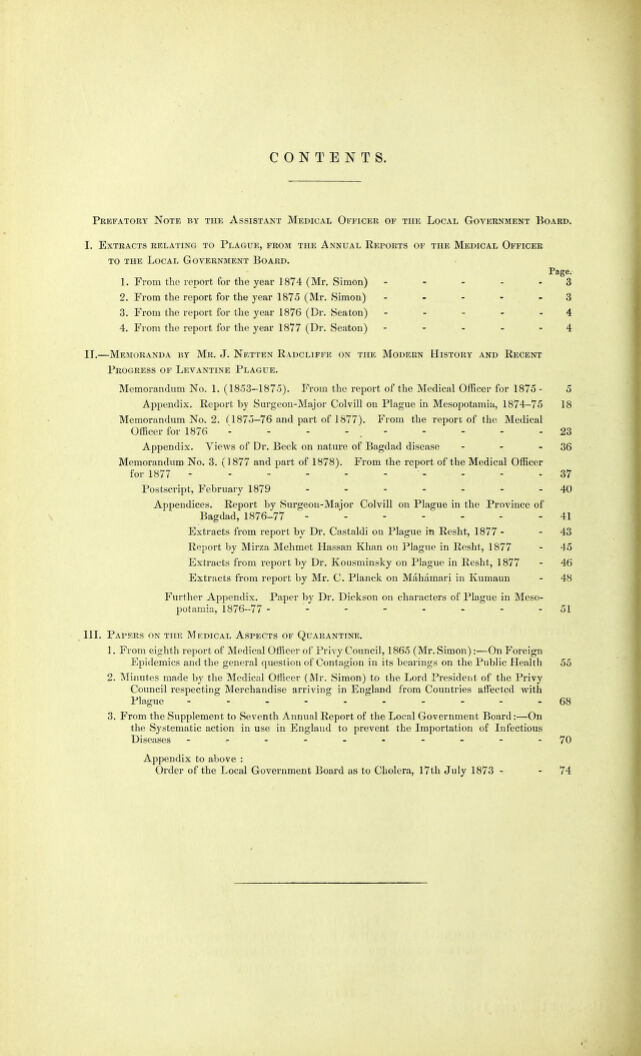
Plague : papers relating to the modern history and recent progress of Levantine plague / prepared from the time to time by direction of the president of the Local Government Board, with other papers ; sented to both House of Parliament by Command of Her Majesty.
- Radcliffe, Netten.
- Date:
- 1879
Licence: Public Domain Mark
Credit: Plague : papers relating to the modern history and recent progress of Levantine plague / prepared from the time to time by direction of the president of the Local Government Board, with other papers ; sented to both House of Parliament by Command of Her Majesty. Source: Wellcome Collection.
Provider: This material has been provided by Royal College of Physicians, London. The original may be consulted at Royal College of Physicians, London.
66/82 page 60
![down at 4i cases of yellow fever, resulting in 26 deaths from the disease. It was stated that, at the time when the Anne Marie arrived in port, there was no other vestige of yellow fever at St. Nazaire, or in its neighbourhood; that neither yellow lever nor anything like it had ever before existed in the district; and that no other yellow fever was seen in that summer on this side of the Atlantic. The description given of St. Nazaire was this:— The town is partly built on the strand, and is tolerably healthy : its vicinity is marshy, and subject to intermittent fevers—perhaps more than usually so this year: nevertheless, nothing uncommon was observed in the state of public health.'' The weather is said to have been extremely hot more like that of a tropical than of an European climate. Before closing my account of these two little outbreaks of yellow fever in ex- ceptionally northern latitudes, I ought to state that, though nothing of quite the same sort had previously occurred either in England or Prance, yet, in both countries, some slight and almost overlooked warnings, to the same general effect, had been given. Thus, in Erance, though apparently yellow fever had never touched the ordi- nary land-population or spread from ship to ship any where so far north as St. Nazaire, probably, on a few occasions, and in a very small amount, the disease had been seen in the quarantine establishment of a still more northerly port—that of Brest, attack- ing now and then some official whose business had been with a newly arrived infected ship.* Dr. Buchanan's inquiry at Swansea elicited that probably on two or three occasions a solitary case of yellow fever had occurred there under like circumstances. At Southampton too, on one occasion, in 1852, it happened that an engineer of an infected ship was attacked with yellow fever on shore eight days after the ship's arrival in port.f And it is alleged that also at Southampton, in the years 1852-3, the landing of yellow fever patients from infected ships led on three occasions to ill results, as follows :—that in one case, witnessed by Mr. Wibliu in December 1852, it was believed that a convalescent from yellow fever infected two members of his family, who afterwards infected three others, with illness much less severe than ordi- nary yellow fever, but having at least some affinity to it; that in another case, witnessed by Mr. Dusautoy, in the summer of 1853, a woman died with symptoms of yellow fever shortly after having washed the clothes of a seaman who had been landed with that disease; that, in the remaining case witnessed by Mr. Wiblin in July 1853, it was believed that a yellow fever patient, taken to the Southampton poor-house, communicated his disease, in a fatal form, to another inmate of the establishment. It is proper to add that, in some of the above cases, medical controversy was raised as to the nature of the disease. Of course no absolute judgment can now be given on both these persons had been exposed to chances of direct infection from the ship,] In some other cases, persons who apparently had not been near any affected ship, but had attended patients from the Chastan, were attacked, though but slightly, with symptoms very suggestive of yellow fevei-. M. Melier's belief Avith regard to the several just cited cases is, that they were cases of true contagion, using the word ' contagion' in the sense in which we call smallpox and typhus contagious. Without pretending to controvert this belief (which on other grounds may or may not be tenable) 1 would observe that it is not a necessary consequence of the facts recorded in the present papers. The facts, supposing no exception taken to them, would be to this effect:—that labourers who had spent time in the hold of the Anne Marie, and had caught yellow fever there, carried with them some power of infection ; and that a like power, much feebler in degree, went also with the crew of the Chastan. But almost unquestionably, with regard to the Anne Marie, and not improbably with regard to the Chastan, it seems that the ship, irrespectively of sick persons in it, was a focus of yellow fever infection. And, on this showing, the alleged facts admit of more than one interpretation. Whether, namely, the men carried infection because they themselve had contracted yellow fever, or merely carried infection passively as they might have carried an odour from the ship,—whether men who had laboured in the hold of the Aime Marie without themselves contracting yellow fever there might equally have carried infection to their homes,—whether they who carried infection might have been disinfected by soap and water and change of dress,—whether, in short, the infective power belonged, not to the sick body, as such, and to its excretions and discharges, but to the mere washable surface and clothing which had been saturated with the atmosphere of the ship ; this question remains unanswered by facts in the present record. And I draw attention to that openness of the question, because of its all-important bearing on the practical issue, whether it was necessary to adopt at St. Nazaire the system of personal quarantine which certain of M. Melier's regulations enforced. —-Extract from OfBce-Memoraudum on the St. Nazaire outbreak. The distinctions which I have drawn as to the mode in which yellow fever might have been (if it M'as) communicated by personal intercourse at St. Nazaire, and the doubts which 1 have intimated as to the provenness of true contagion there, are equally applicable to the discussion ci the somewhat similar facts which are reported tohave occurred 13 or 14 years ago at Southampton. * Particulars of one such occurrence (which took place in 1856) are given in the Bulletin de I'Academie de Medecine, vol. xxii. I See the case, as reported by Mr. Wiblin, in the (Lancet) of 185o. I may note here that the ship was a wooden one, and that the engineer, though lodging on shore, had been spending much of his time in the ship. Also 1 may note that iu our present ignorance as to the incubation-time of yellow fever, we cannot absolutely say that the disease was not latent in the man when he first landed.](https://iiif.wellcomecollection.org/image/b24751388_0068.jp2/full/800%2C/0/default.jpg)