Decisions of the English, Scottish and Irish courts under the Medical Acts 1858 to 1886 and the Dentists Act 1878 : collected for the General Medical Council and arranged with introduction and notes / by Charles J. S. Harper.
- Harper, Charles John Stewart.
- Date:
- 1912
Licence: In copyright
Credit: Decisions of the English, Scottish and Irish courts under the Medical Acts 1858 to 1886 and the Dentists Act 1878 : collected for the General Medical Council and arranged with introduction and notes / by Charles J. S. Harper. Source: Wellcome Collection.
Provider: This material has been provided by The University of Leeds Library. The original may be consulted at The University of Leeds Library.
142/444 page 82
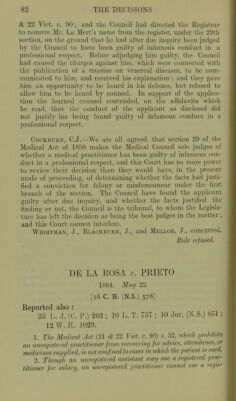
![& 22 Vict. c. 90; and the Council had directed the Registrar to remove Mr. La Mcrt's name from the register, under the 29th section, on the ground that lie had after due inquiry been judged by the Council to have been guilty of infamous conduct in a professional respect. Before adjudging him guilty, the Council had caused the charges against him, which were connected with the publication of a treatise on venereal diseases, to be com- municated to him, and received his explanation ; and they gave him an opportunity to be heard in liis defence, but refused to allow him to be heard by counsel. In support of the applica- tion the learned counsel contended, on the affidavits which he read, that the conduct of the applicant as disclosed did not justify his being found guilty of infamous conduct in a professional respect. CocKBURN, C.J.—We are all agreed that section 29 of the Medical Act of 1858 makes the Medical Council sole judges of whether a medical practitioner has been guilty of infamous con- duct in a professional respect, and this Court has no more power to review their decision than they would have, in the present mode of proceeding, of determining whether the facts had justi- fied a conviction for felony or misdemeanour under the first branch of the section. The Council have found the apphcant guilty after due inquiry, and whether the facts justified the finding or not, the Council is the tribunal, to whom the Legisla- ture has left the decision as being the best judges in the matter ; and this Court cannot interfere. WiGHTMAN, J., Blackburn, J., and Mellor, J., concurred. Rule refused. DE LA EOSA v. PRIETO 1864. May 22. [i6 C. B. (N.S.) 578] Eeported also : 33 L. J. (C. P.) 262 ; 10 L. T. 757 ; 10 Jur. (N.S.) 851 ; 12W.E. 1029. 1. The Medical Act (21 <& 22 Vict. c. 90) s. 32, ivJtich prohibils an unregistered practitioner from recovering for advice, attendance, or medicines supplied, is not confined to cases in which the patient is sued. 2. Though an unregistered assistant may sue a registered prac- titioner for salary, an urtregistered practitioner cannot sue a regis-](https://iiif.wellcomecollection.org/image/b21508100_0142.jp2/full/800%2C/0/default.jpg)
 No text description is available for this image
 No text description is available for this image
 No text description is available for this image