Decisions of the English, Scottish and Irish courts under the Medical Acts 1858 to 1886 and the Dentists Act 1878 : collected for the General Medical Council and arranged with introduction and notes / by Charles J. S. Harper.
- Harper, Charles John Stewart.
- Date:
- 1912
Licence: In copyright
Credit: Decisions of the English, Scottish and Irish courts under the Medical Acts 1858 to 1886 and the Dentists Act 1878 : collected for the General Medical Council and arranged with introduction and notes / by Charles J. S. Harper. Source: Wellcome Collection.
Provider: This material has been provided by The University of Leeds Library. The original may be consulted at The University of Leeds Library.
145/444 page 85
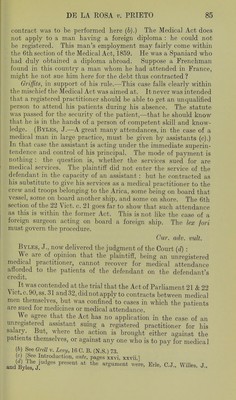
![contract was to be performed here (b).) The Medica] Act does not apply to a man having a foreign diploma : he could not be registered. This man's employment may fairly come within the 6th section of the Medical Act, 1859. He was a Spaniard who had duly obtained a diploma abroad. Suppose a Frenchman found in this country a man whom he had attended in France, might he not sue him here for the debt thus contracted ? Grifjits, in support of his rule.—This case falls clearly within the mischief the Medical Act was aimed at. It never was intended that a registered practitioner should be able to get an unqualified person to attend his patients during his absence. The statute was passed for the security of the patient,—that he should know that he is in the hands of a person of competent skill and know- ledge. (Byles, J.—A great many attendances, in the case of a medical man in large practice, must be given by assistants (c).) In that case the assistant is acting under the immediate superin- tendence and control of his principal. The mode of payment is nothing : the question is, whether the services sued for are medical services. The plaintiif did not enter the service of the defendant in the capacity of an assistant: but he contracted as his substitute to give his services as a medical practitioner to the crew and troops belonging to the Arica, some being on board that vessel, some on board another ship, and some on shore. The 6th section of the 22 Vict. c. 21 goes far to show that such attendance as this is within the former Act. This is not like the case of a foreign surgeon acting on board a foreign ship. The lex fori must govern the procedure. Cur. adv. vult. Byles, J., now delivered the judgment of the Court {d) : We are of opinion that the plaintiff, being an unregistered medical practitioner, cannot recover for medical attendance afforded to the patients of the defendant on the defendant's credit. It was contended at the trial that the Act of Parhament 21 & 22 Vict.c 90,ss. 31 and 32, did not apply to contracts between medical men themselves, but was confined to cases in which the patients are sued for medicines or medical attendance. We agree that the Act has no application in the case of an unregistered assistant suing a registered practitioner for his salary. But, where the action is brought either against the patients themselves, or against any one who is to pay for medical (6) See Orell v. Levy, 16 C. B. (N.S.) 73. fcl &® Introduction, ante, pages xxvi, xxvii.] and Byle3,7 ^''^ ''^ argument were, Erie, C.J., WiUes, J.,](https://iiif.wellcomecollection.org/image/b21508100_0145.jp2/full/800%2C/0/default.jpg)
 No text description is available for this image
 No text description is available for this image
 No text description is available for this image