Report of the Medical Officer of Health on the public health and sanitary circumstances of Johannesburg.
- Johannesburg
- Date:
- [1909]
Licence: Public Domain Mark
Credit: Report of the Medical Officer of Health on the public health and sanitary circumstances of Johannesburg. Source: Wellcome Collection.
10/118 page 6
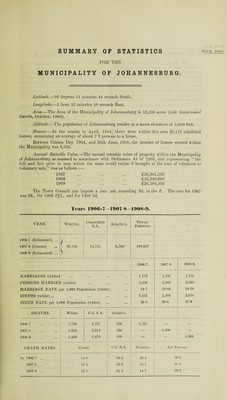
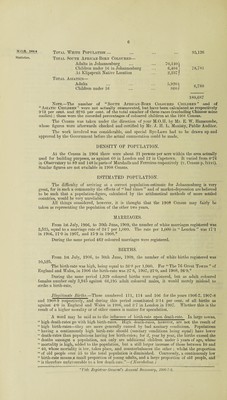
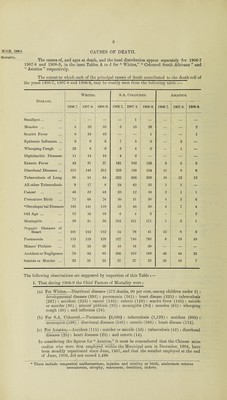
![M.O.H. 190G-9 Statistics. Total White Population... .. • . . . 95,126 Total South African-Born Coloured— Adults in Johannesburg ... 70,140] Children under 16 in Johannesburg ... 6,404 J- 78,781 At Klipspruit Native Location 2,237 J Total Asiatics— Adults . . . 5,920 \ 6,780 180,687 Children under 16 860 j Note.—The number of “ South African-Born Coloured Children ” and of “ Asiatic Children ” were nob actually enumerated, but- have been calculated as respectively 913 per cent, and 22'85 per cent, of the total number of these races (excluding Chinese mine coolies) : these were the recorded percentages of coloured children at the 1904 Census. The Census was taken under the direction of your M.O.H. by Mr. E. W. Hanscombe, whose figures were afterwards checked aud certified by Mr. J. H. L. Manisty, Public Auditor. The work involved was considerable, and special Bye-Laws had to be drawn up and approved by the Government before the actual enumeration could be made. DENSITY OF POPULATION. At the Census in 1904 there were about 21 persons per acre within the area actually used for building purposes, as against 60 in London and 12 in Capetown. It varied from 0‘76 in Observatory to 89 and 148 in parts of Marshalls and Ferreiras respectively (v. Census p. lxxvi). Similar figures are not available in 1908 Census. ESTIMATED POPULATION. The difficulty of arriving at a correct population-estimate for Johannesburg is very great, for in such a community the effects of “ bad times ” and of market-depression are believed to be such that a population-figure, calculated by the arithmetical methods of more settled countries, would be very unreliable. All things considered, however, it is thought that the 1908 Census may fairly be taken as representing the population of the other two years. MARRIAGES. From 1st July, 1906, to 30th June, 1909, the number of white marriages registered was 3.525, equal to a marriage rate of 247 per 1,000. The rate per 1,000 in “ London ” was J7’1 in 1906, 17'0 in 1907, and 15*9 in 1908.* During the same period 462 coloured marriages were registered. BIRTHS. From 1st July, 1906, to 30th June, 1909, the number of white births registered was 10.525. The birth-rate was high, being equal to 36‘S per 1,000. For “ The 76 Great Towns ” of England and Wales, in 1906 the birth-rate was 27'8, 1907, 27‘0, and 1908, 26*9,* During the same period 1,929 coloured births were registered, but as adult coloured females number only 3,945 against 66,195 adult coloured males, it would merely mislead to strike a birth-rate. Illegitimate Births.—These numbered 111, 114 and 106 for the years 1906-7, 1907-8 and 1908-9 respectively, and during this period constituted 3*14 per cent, of all births as against 4*0 in England and Wales in 1906, and 3*7 in London in 1907. Whether this is the result of a higher morality or of other causes is matter for speculation. A word may be said as to the influence of birth-rate upon death-rate. In large towns, “ high death-rates go with high birth-rates. High death-rates, however, are not the result of “ high birth-rates—they are more generally caused by bad sanitary conditions. Populations “ having a continuously high birth-rate should (sanitary conditions being equal) have lower “ death-rates than populations having low birth-rates; for if, year by year, the births exeeed the “ deaths amongst a population, not only are additional children under 5 years of age, whose “ mortality is high, added to the population, but a still larger increase of those between 10 and “ 40, whose mortality is low, takes place, and counterbalances the other ; whilst the proportion “ of old people over 55 to the total population is diminished. Conversely, a continuously low “ birth-rate means a small proportion of young adults, and a large proportion of old people, and “ is therefore unfavourable to a low death-rate.”—(Newsholme.) * Vide Registrar-General's Annual Summary, 190G-7-S.](https://iiif.wellcomecollection.org/image/b31487762_0010.jp2/full/800%2C/0/default.jpg)